
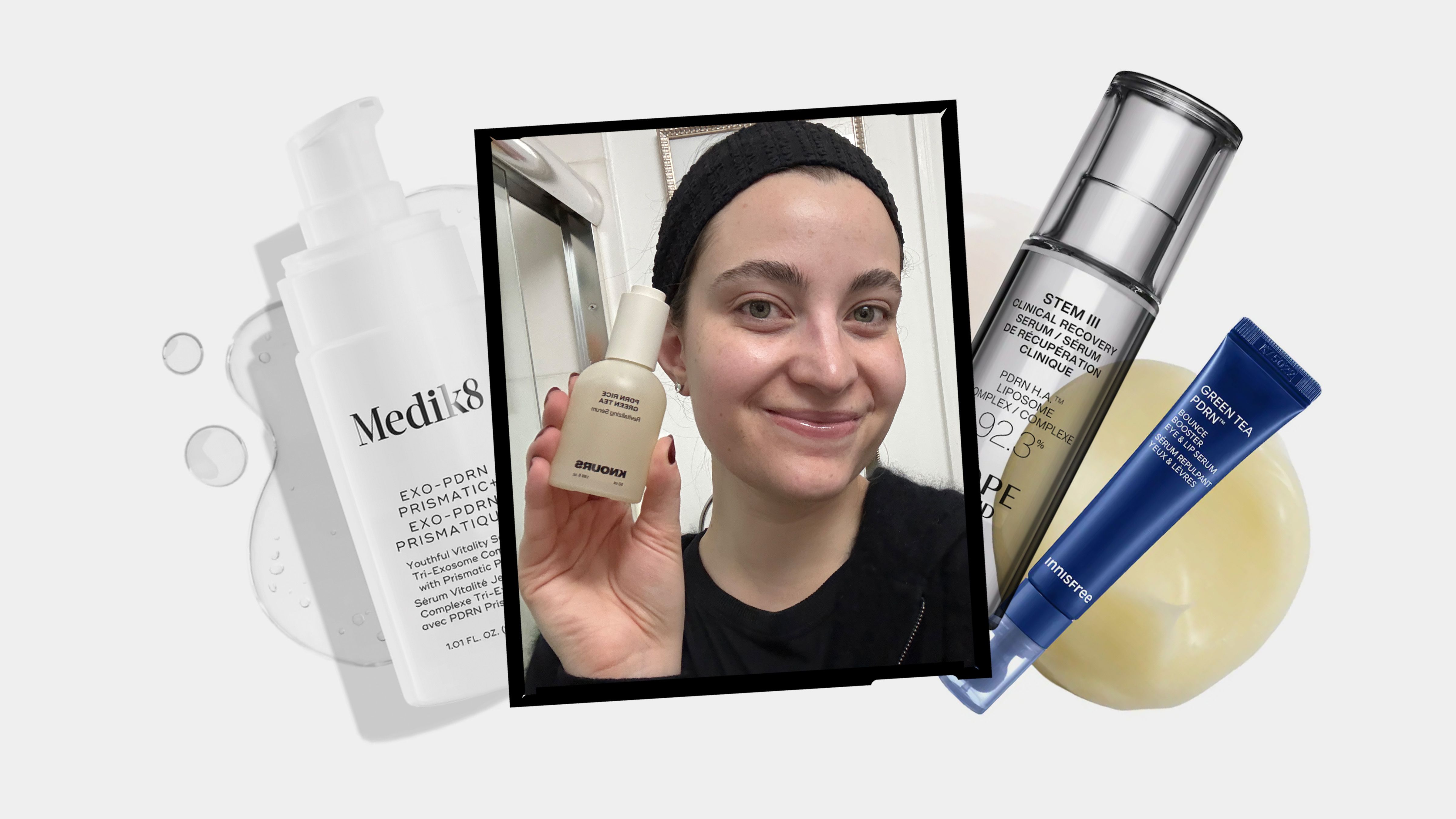
Collage: Paula Balondo; Source images: Courtesy of brands Save Story Save this story Save Story Save this story PDRN seems to be everywhere right now, but can even the best PDRN serums really deliver all the skin-smoothing, barrier -strengthening benefits people claim? Before you start slathering on salmon sperm DNA (yes, really), it helps to understand more about one of the buzziest ingredients to emerge from K-beauty . “PDRN, or polydeoxyribonucleotide, refers to DNA fragments that are most commonly derived from salmon sperm DNA,” says Jane Yoo , MD, a dual board-certified dermatologist and Mohs surgeon based in New York City. It's been used in regenerative medicine for years in Europe and Asia, where "there is credible clinical use of [injectable] PDRN in medical settings for wound healing and ulcers,” Mona Gohara , MD, a board-certified dermatologist in Hamden, Connecticut, previously told Allure , who noted that it's generally well-tolerated.
The thinking behind PDRN is that it can supposedly target certain receptors on your cells. “Think of the skin cell as a ball, and the receptor is sticking out on top of it like a light switch,” said Dr. Gohara. “PDRN injections are basically turning on the switch to wake up the cells and hopefully get them to produce more collagen .” It's historically been used as an injectable skin booster abroad, where it's offered as a “regenerative” skin booster as well as part of post-procedure recovery after lasers, chemical peels, and microneedling. PDRN injections are not approved by the FDA for cosmetic skin rejuvenation and are not legally used for those purposes in the United States.
Whether that translates to topical products, though, is still unclear. There’s a difference between hype and hard evidence, “and I’m skeptical as to how well the data is substantiating PDRN’s skin-care claims,” Kelly Dobos , a Cincinnati-based cosmetic chemist, previously told Allure . So far, much of the research on PDRN as a skin-care ingredient has taken place in petri dishes, which don’t account for the many complexities of human skin cells. “The evidence that we have on PDRN’s benefits is in cell cultures, where it can do things like turn off melanin production. That’s not the same thing as saying, ‘If you put this in a cream, and put that on your skin, it’s going to work,’” Perry Romanowski , a Chicago-based cosmetic chemist, previously told Allure .
And while topical PDRN has become a buzzy skin-care ingredient, there’s currently little clinical evidence showing that PDRN serums deliver the same benefits seen when it’s injected. That doesn’t necessarily mean these formulas can’t improve the look of your skin, but rather that it’s difficult to know how much of the credit belongs to PDRN itself. Many of the products on this list also contain well-studied ingredients like hyaluronic acid, peptides, niacinamide, and retinoids, which have years of evidence to back up their ability to hydrate, smooth, brighten, and plump the skin.
So while the jury is still out on topical PDRN, the supporting cast in these formulas may be doing much of the heavy lifting. Still game to see whether it works for you? The PDRN-infused products our editors and dermatologists keep reaching for.
Why has PDRN become so popular in Korean skin care specifically? Does PDRN skin care actually work? What is plant-derived PDRN? Is it worth using if you’re already using ingredients like retinol,…