
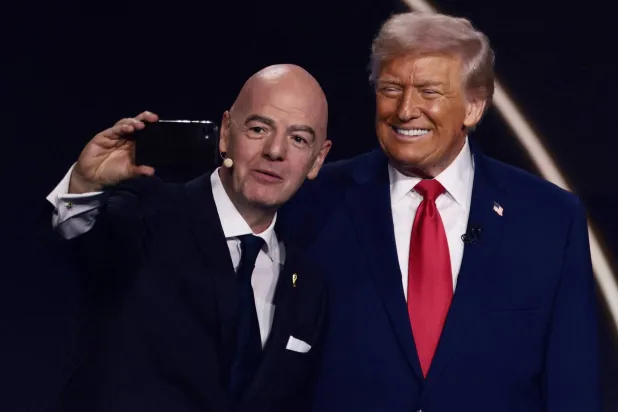
The phone call made by US President Donald Trump to the President of FIFA, Gianni Infantino, requesting a reconsideration of the red card received by Folarin Balogun, was not the first recorded case of political intervention in the history of the World Cup.
In 1934, fascist Italy hosted the second edition of the World Cup, and the dictator, who unlike his people did not love football, saw in the event a perfect opportunity to glorify his political regime.
Mussolini attended all the matches and went to the dressing rooms, while the refereeing appeared clearly biased towards the host country, which ultimately claimed the title, to the extent that FIFA later decided to suspend two referees for life.
In 1938, a year before the outbreak of World War II, Austria, which had recently been annexed to Nazi Germany, announced its withdrawal, and several of its players were forced to play for the German national team, having to perform the Nazi salute at the Parc des Princes stadium. Nevertheless, Germany did not go beyond the Round of 16.
Italy retained its title in a tournament where its players wore black shirts reminiscent of the Italian militia uniforms. Before the final against Hungary (4-2), Mussolini sent them a short yet terrifying message: “Win or die.”
Hungarian goalkeeper Antal Sabo commented on Mussolini's controversial telegram, saying: “It’s true I let in four goals, but at least I saved the lives of 11 men.”
In 1978, the tournament was held under the dictatorship of General Jorge Rafael Videla, aimed at polishing the regime's image, and saw Argentina crowned its first title amidst strong corruption suspicions.
To reach the final, Argentina had to win against Peru by at least four goals to surpass Brazil. However, the Peruvian team, which seemed defensively strong at the tournament's start, collapsed and lost by a clean six.
Over the years, without conclusive proof, several testimonies have spoken of a suspected agreement between the two regimes.
In 2026, Donald Trump was dissatisfied with the red card received by Folarin Balogun during the United States' victory over Bosnia and Herzegovina in the Round of 32, which meant an automatic suspension from the next match against Belgium, and he contacted FIFA President Gianni Infantino demanding a reconsideration of the decision.
Four days later, FIFA announced that the Disciplinary Committee had amended the punishment; the one-match suspension was converted to a “suspension with probation for one year.”
As a result, the US team's top scorer in this tournament will be able to participate in the Seattle match on Monday against the “Red Devils.”