
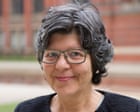
Beth McKillop’s interest in Korea began almost by accident. While working in the Chinese section of the British Library during the early 1980s, she recognised that the institution’s Korean collections lacked specialist expertise. Photograph: V&A Beth McKillop’s interest in Korea began almost by accident. While working in the Chinese section of the British Library during the early 1980s, she recognised that the institution’s Korean collections lacked specialist expertise. Photograph: V&A Art Obituary Beth McKillop obituary Museum curator and scholar with a special focus on Korean art
Prefer the Guardian on Google Long before Korean film, television and music achieved global prominence, the curator and scholar Beth McKillop, who has died of metastatic breast cancer aged 72, was arguing that Korean artistic traditions deserved attention in their own right, rather than as a footnote to the histories of China or Japan .
Through her work at the Victoria & Albert Museum and at the British Library , McKillop helped transform how Korean art was understood, introducing visitors, students and researchers to the country’s ceramics, books and design, and helping establish a field that is now central to the study of east Asian art in Britain.
Her greatest achievement came between 1990 and 1993, when she was seconded from the British Library to the V&A as Samsung curator of Korean art, and established the UK’s first permanent museum gallery dedicated to the subject. Drawing on relationships she developed across South Korea , McKillop expanded the V&A’s Korean holdings by more than 120 objects, both historical and contemporary.
These included a striking celadon vase (1990) by the ceramic artist Shin Sang-ho , which exemplifies the dialogue between tradition and innovation that McKillop sought to highlight. As she noted in her catalogue, “the vase pays homage to the Koryŏ tradition [AD918-1392] with its spreading rim, small loops at the shoulders, and delicately inlaid pair of white and black cranes in flight”, yet diverges with its angular body.
“The trunk of a pine tree seems to grow out of one of the edge lines that divide the bottle into irregular facets, and its leaves trail into the lines of the glaze crackle.”
As well as ceramics, the gallery introduced visitors to Korean textiles, furniture and decorative arts. A late-19th-century colourful folding screen depicts the four seasons with birds and flowers. A wonsam bridal robe made by the fashion designer Lee Young-hee , shows how traditions continue to evolve. A 1991 tanch’ŏng painting (used to decorate wooden architecture) demonstrates the mastery of the Buddhist monk the Venerable Yi Man-bong .
McKillop’s interest in Korea began almost by accident. While working in the Chinese section of the British Library during the early 1980s, she recognised that the institution’s Korean collections lacked specialist expertise. Supported by the library, she began studying Korean at the School of Oriental and African Studies (now Soas University of London) under William Skillend , one of the founders of Korean studies in Britain. What started as a practical response to a curatorial need became the defining intellectual commitment of her career.
View image in fullscreen Detail from a 19th-century Korean flower and bird screen. Photograph: Clare Johnson/Victoria & Albert Museum, London Born in Glasgow , Beth was the eldest daughter of four children born to Mary (nee Chalmers), a teacher, and Norman McCo...