
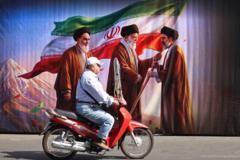
BBC News, Arabic Go to content Main See Listen Main Sections News Economy Health & Sciences Culture & Arts World Cup 2026 Investigations News Economy Health & Sciences Culture & Arts World Cup 2026 Investigations How does the new Iranian regime differ significantly from what it was before? Image source, AFP via Getty Images
When U.S. President Donald Trump signed a ceasefire agreement with Iran during a dinner at the Palace of Versailles last month, many saw it as a paradox.
Perhaps his host, French President Emmanuel Macron, wanted to ensure that a memorandum of understanding was signed before Trump changed his mind, and perhaps he also figured that the gilded Hall of Mirrors would appeal to his guest.
But the choice of venue inevitably invited comparisons between the agreement, which barely exceeds a page and a half, and the very long Treaty of Versailles signed in 1919 at the end of World War I, which redrew the map of Europe, but its demands for massive reparations left Germany angry and resentful, contributing to paving the way for another world war just 20 years later.
Can the agreement with Iran, despite its many differences, be seen as a similarly pivotal event?
Three weeks later, the fragile ceasefire still holds to some extent. But after clashes in the Strait of Hormuz and its surroundings, and with none of the issues that led to the war close to resolution, the situation in the Middle East seems as fragile as it was before.
This comes at a time when Iran is undergoing a profound transition.
The country is bidding farewell to its former Supreme Leader, Ayatollah Ali Khamenei, who was killed more than four months ago in devastating U.S.-Israeli airstrikes that ignited the war and toppled much of the regime's leadership in Tehran.
It's an important moment; a big reminder that the old guard has made way for a new generation. With the new faces comes a new approach with its own implications.
While the United States and Israel may have sent many of the country’s former leaders to their graves early, have they been replaced by even fiercer adversaries?
It deserves deep attention to explain the prominent events and topics, to help you understand the most important changes around you and their impact on your life.
Will Nasser, Professor of International Affairs and Middle Eastern Studies at the Johns Hopkins School of Advanced International Studies, said: "This war is much more important and much larger than we have given it credit for so far."
He added: "All major wars of this size ultimately rearrange the chessboard. And this war will do that in the Middle East."
In January, popular protests erupted in Iran, with Trump and Israeli Prime Minister Benjamin Netanyahu expecting that they might pave the way for the collapse of the Islamic Republic.
Iran’s economy suffered widespread collapse after decades of international sanctions. The country was also still severely affected by a 12-day war with the United States and Israel six months ago.
Tehran's nuclear program, which has long served as a diplomatic pressure tool, was not completely obliterated as Trump bragged, but it was significantly damaged.
The location of the uranium stockpile, believed to be enough to make 10 or 11 nuclear weapons if enriched further, was not confirmed, but a large portion of it was believed to be buried under the rubble near the Isfahan nuclear complex.
More broadly, the Iranian "axis of resistance," a loose coalition of proxies and allies across the Middle East, faced a series of major setbacks.
In Syria, Bashar al-Assad's regime, a close ally of Iran, fell within a few fast-moving weeks at the end of 2024.
In Lebanon, Israel assassinated prominent figures in the Iran-backed Hezbollah and dealt significant losses to its fighters through the bombing of pagers and radio communication devices.
In Gaza, another Iranian ally, Hamas, faced a similar fate. Israel responded to the group’s devastating attacks in October 2023 with an ongoing assault that destroyed large parts of Gaza and killed tens of thousands of civilians.
When Iranian-backed Houthis in Yemen launched ballistic missiles at Israel and began attacking ships in the Red Sea - in response to the Gaza War - it launched...