
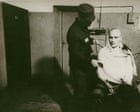
Gripping … a still from The Last Judgement directed by Herz Frank. Photograph: Rīgas Kinostudija View image in fullscreen Gripping … a still from The Last Judgement directed by Herz Frank. Photograph: Rīgas Kinostudija Film Review The Story of Documentary Film (The 1980s) review – Mark Cousins educates and intrigues once more Karlovy Vary film festival The film-maker and critic traces a decade of documentaries, from the fall of the Berlin Wall to Michael Moore, via Klaus Barbie and The Wombles
Peter Bradshaw Sun 5 Jul 2026 15.00 CEST Last modified on Sun 5 Jul 2026 19.09 CEST Share Prefer the Guardian on Google T he unmistakable film-making voice of documentary-maker and critic Mark Cousins is raised again, to educate, to intrigue, to challenge. His histories of the movies are invitations to a seance, a chance to participate in the kind of ecstatic trance or dream-state that Cousins himself goes into, almost free-associating from film to film but with an overarching but discreetly emphasised theme – or maybe motif – and always with something shrewd, pertinent and humane to say. I have never watched a Cousins film without feeling that I have learned something new, and so it has proved again.
At Karlovy Vary, he is presenting part of his monumental new The Story of Documentary Film, which comprises 16 hour-long chapters, and of these he is here giving us numbers Eight and Nine, about the 1980s. The first of these begins and ends at the site of Checkpoint Charlie on the Berlin Wall which came down at the end of the decade; Cousins subtitles this episode with a line from Robert Frost: “Something there is that doesn’t love a wall.” His theme here is empathy, surmounting the obstacle (or wall) of indifference or ignorance; and he talks about the films that questioned the existing order and which pulled away the bricks that caused the Soviet wall to collapse. The second part (chapter nine) is subtitled “detectives”, about the investigative documentaries that demanded answers, particularly to questions about the wartime past, by people like Marcel Ophuls , Claude Lanzmann and Michael Moore.
Often, Cousins can’t resist a cinephile gag. Ophuls, director of Hotel Terminus: The Life and Times of Klaus Barbie (1988), about the horrendous Gestapo chief, compared his dogged sleuthing to that of TV’s rumpled cop Columbo – and Cousins drops in a clip of Peter Falk’s legendary detective, and can’t resist using the episode that was directed by a young Steven Spielberg. Yet this episode also focuses on music documentaries; it cheekily begins and ends on Jimmy Somerville and Bronski Beat, that most intensely 80s musical sound.
These episodes are a treasure trove of material. Cousins gives us fascinating clips: perhaps the most gripping, for me, is from The Last Judgement (1987), by Latvian director Herz Frank, a Dostoyevskian film about a man on death row for murder, who claims to the very last that he loves all mankind, even or especially the people who are going to execute him. Also from Latvia is Juris Podnieks’s Is It Easy to Be Young? (1986), a movie about youth culture whose rebellious energy was a challenge to the sclerotic dullness and mediocrity of the Soviet state. But in the west, Jan Troell’s epic essay movie Land of Dreams (1988) questioned the bland complacency of Sweden and its conformist and un-creative kind of progressive politics.
View image in fullscreen Demanding answers … a still from Shoah by Claude Lanzmann The next part brings u…