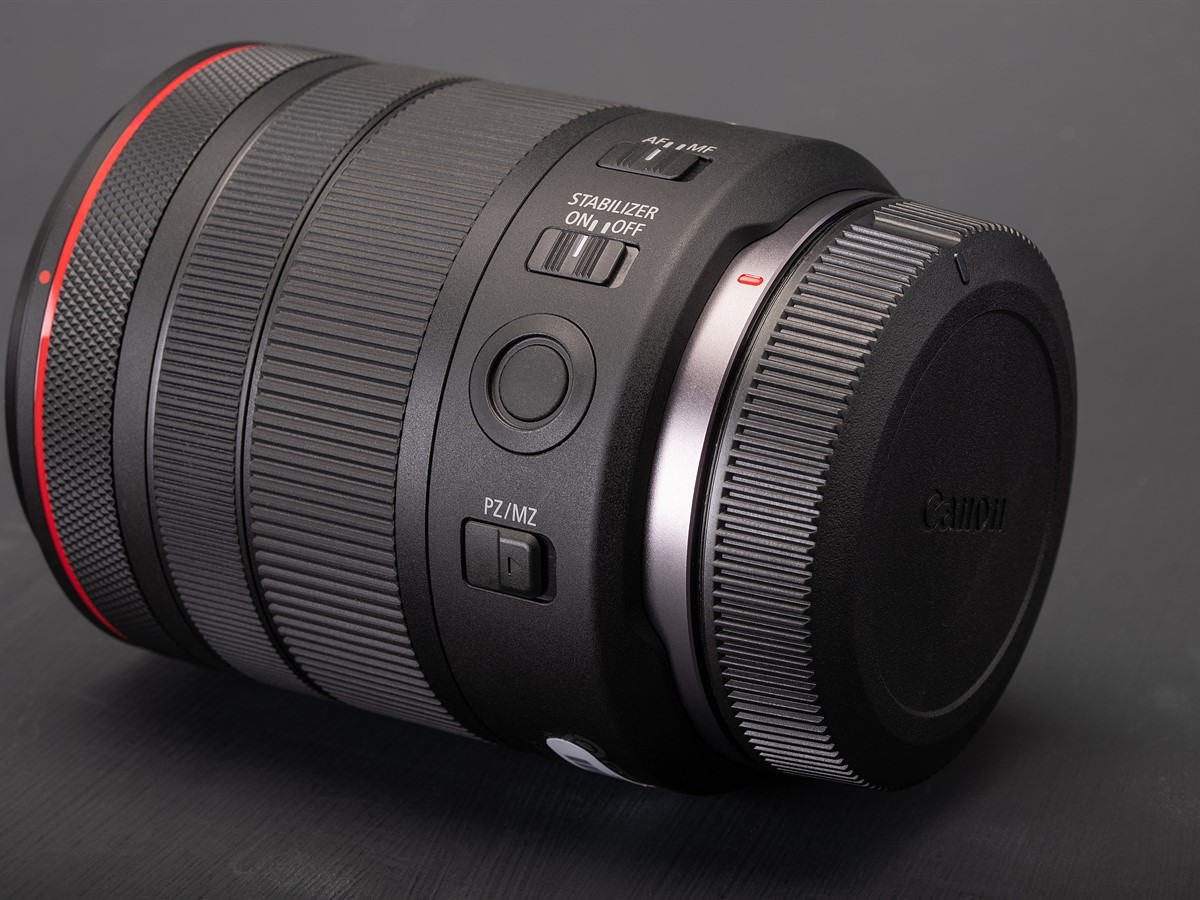
When you use DPReview links to buy products, the site may earn a commission. The key to the Canon RF 20-50mm F4 L IS USM PZ for photographers is the switch to go between power and manual zoom mode. Alongside the EOS R6 V, Canon introduced the 20-50mm F4 L IS USM PZ. Like most power-zoom lenses, it's clearly mainly focused at video users who have access to a zoom toggle at their fingertips. But Canon made the unusual decision to take a hybrid approach; with the flick of a switch, you can control the zoom in the traditional manner by rotating a ring on the lens barrel between two fixed points. We're in the process of testing the EOS R6 V, but thought it'd be worth taking the lens out to shoot a few photos, too, to see if it also makes a decent photo lens on a camera without that zoom lever. To answer the most obvious question first: no, the manual zoom mode isn't mechanical. The lens's focal length is still controlled by the power zoom motors, and there is an ever-so-slight delay between you turning the ring and the lens arriving at its destination. The lens is pretty quick, so it's not too noticeable if you're just zooming in slightly, but you can definitely see (and maybe hear) it if you're going from 20mm to 50mm. This somewhat breaks the illusion of direct control that the manual zoom portion of the lens is designed to add. It also doesn't help that the ring is just a bit too easy to turn. That both makes it easy to accidentally change your zoom level when you didn't mean to, and acts as another signal to your brain that you're actually remote-controlling something, rather than physically moving parts of the lens yourself. The good news is that, unless you bump the zoom ring, the lens will retain its focal length setting when you turn the camera body off; unlike with a compact camera, you don't have to wait for it to move back through its range to 50mm when you turn your camera back on. However, if you move the zoom ring while the camera's off (accidentally or otherwise), you'll have to wait an extra moment or two for the lens's motors to change its focal length when you turn the camera back on, during which time you won't have any live view preview. I also found the 20-50mm focal length to be quite enjoyable to shoot. I'm a fan of 50mm, so I don't mind it ending there if it means a smaller lens, and being able to go that bit wider came in handy quite often. Canon EOS R5 II | Canon RF 20-50mm F4 L IS USM PZ @ 21mm | F8 | 1/250 sec | ISO 100 | Processed with Capture One While I imagine some photographers may be disappointed reading the above, I'll also say this: after about an hour or two of shooting with the lens, I mostly stopped noticing the quirks. That's not something I can say about any of the other power zooms I've shot photos with, which were always that bit more annoying to use. Sure, the experience of using the 20-50mm isn't the same as using a mechanically zooming lens. But it's also much nicer for photography than a traditional power zoom that can only be controlled with a rocker or finicky on-lens control. The W - T control on the lens isn't just a toggle. If you only push it a bit towards either end, it'll move through the range slowly. Push if further, and the zoom will happen faster. For those who care about video, the story is more straightforward: this lens is really nice to use, especially if the camera it's on has a zoom toggle. Even if it doesn't, the power zoom control on the lens works well. With a bit of finesse, you can use it for slow, purposeful pushes or pulls, or for crash zooms, depending on how far you push it to the W or T side. There are also times when it's nice to use it in the manual zoom mode, where how easy the ring is to turn becomes a feature, rather than a bug. I've always found it quite difficult to get smooth zoom pushes or pulls using a lens's traditional mechanical zoom ring, but with this lens, it's a breeze, while still offering a bit finer-grained control than the traditional power zoom control. Buy now: Buy at Adorama Buy at B&H Photo Canon RF 20-50mm F4 L IS USM PZ specifications: Principal specifications Lens typeZoom lens Max Format size35mm FF Focal length20–50 mm Image stabilizationYes CIPA Image stabilization rating6 stop(s) Lens mountCanon RF, Canon RF-S Aperture Maximum apertureF4 Minimum apertureF22 Aperture ringNo Number of diaphragm blades9 Optics Elements13 Groups11 Special elements / coatings2 GMo aspheric, 3 UD Focus Minimum focus0.24 m (9.45″) Maximum magnification0.33× AutofocusYes Motor typeStepper motor Full time manualYes Focus methodInternal Distance scaleNo DoF scaleNo Physical Weight420 g (0.93 lb) Diameter80 mm (3.15″) Length98 mm (3.86″) SealingYes ColourBlack Zoom methodRotary (internal) Power zoomYes Filter thread67 mm Hood suppliedYes Tripod collarNo
Photography & Directing
How does Canon's new approach to power zoom work for photographers?
When you use DPReview links to buy products, the site may earn a commission. The key to the Canon RF 20-50mm F4 L IS USM PZ for photographers is the...
AAdmin
July 6, 2026
5 min read