
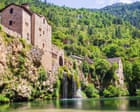
The village of Saint-Chély-du-Tarn, in Lozère, has riverside buildings nestled in the rocks. Photograph: Willy Mobilo/Alamy View image in fullscreen The village of Saint-Chély-du-Tarn, in Lozère, has riverside buildings nestled in the rocks. Photograph: Willy Mobilo/Alamy France holidays Walking in France’s ‘garden of Eden’: a new route in the gorgeous Gorges du Tarn Europe’s longest and most dramatic canyon is replete with exotic wildlife, including kingfishers and beavers, ruined castles and architectural oddities
Prefer the Guardian on Google W e’re sipping chestnut kir on a terrace overlooking the Tarn River in southern France when we hear excited voices from the table beside us: “ Regards! C’est un castor ! ” Below us, a beaver the length of my leg is languidly swimming upstream. We don’t need our binoculars because the Tarn is so clean that almost every fish, frog, pebble and ribbon of weed can be seen with the naked eye, magnified by the clarity of the water. This meandering, jade-green river – which winds from its source in the Cévennes national park to Moissac, just north of Toulouse – is home to trout, perch, carp, otters, frogs, toads, kingfishers and herons. We add “beavers” to our list.
Above us, huge vultures have been drifting all day, cruising the thermals in groups of nine or 10. And when our eyes haven’t been on the river or the sky, they have been welded to the many orchids on the bank: including monkey, bee, military, butterfly, pyramidal and fragrant orchids. Later, we discover that 30 varieties have been recorded in this orchid hotspot.
Enticed by the cooler microclimate provided by the double whammy of a river and a deep gorge, we’re walking a five-day section of one of France’s newest long-distance hiking routes (April, May, early June and late September are among the best times to tackle it). The 300km GR736 officially opened in 2023 and runs from the Tarn’s source to the city of Albi. Three days of the route run directly through the Gorges du Tarn, Europe’s longest and most dramatic canyon, a 33-mile (53km) limestone gully of rock formations and towering cliffs that often rise 500 metres above the river. The gorge is also home to more than 3,000 vultures, as well as cuckoos, nightingales, red-billed choughs and owls.
View image in fullscreen Many beavers inhabit the Tarn riverbank. Photograph: Kiszon Pascal/Getty Images Besides exceptional wildlife, a succession of medieval towns, abandoned hamlets, deserted churches, ruined castles, crumbling terraces and jaw-dropping architectural oddities are dotted along the gorge. Most must be reached on foot, via “ balcon ” paths often dizzyingly (albeit safely) whittled from the gorge itself.
Our walk begins in Le Pont-de-Montvert, a bustling historic town amid the expansive heathery uplands of Mont Lozère, from where the Tarn springs. For two days we traverse an unpeopled, wind-blown wilderness of menhirs, boulders, broom and heather, before descending to wildflower meadows and forests of beech and pine. We walk about 10 to 15 miles a day, unimpeded by bulky backpacks as our luggage is transported in a minivan that arrives promptly at 9am every morning.
We spot a rigged cable-and-basket for hoisting goods over the river: someone appears to be living in this isolated spot It’s only as we descend into the gorge on day three that we begin to encounter a myriad of human-made curiosities. The first is Castelbouc, a semi-troglodytic hamlet of narrow, cobbled streets, wa...