
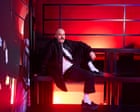
‘I’ve made projects that appear funny to people, but they were about my mother’s suicide’ … Andreas Angelidakis. Photograph: David Levene/the Guardian View image in fullscreen ‘I’ve made projects that appear funny to people, but they were about my mother’s suicide’ … Andreas Angelidakis. Photograph: David Levene/the Guardian Art and design Interview ‘I dealt with death, bankruptcy and HIV in three months’: Andreas Angelidakis on his radical, Ru Paul-influenced art installation Alex Needham Spliff in hand, the Greek artist and architect explains how his Venice pavilion was inspired by Picasso’s Guernica, Charlie Kirk’s widow … and a hatred of pavilions
Wed 8 Jul 2026 17.44 CEST Last modified on Wed 8 Jul 2026 18.18 CEST Share Prefer the Guardian on Google ‘D o you mind if I’m smoking while we’re talking?” enquires Andreas Angelidakis as we both recline on a bean bag in the form of a fallen classical column. “Do you mind if it’s narcotics? If it’s cannabis?” He extracts an elegantly constructed spliff wrapped in pink cigarette paper from his black Nike windcheater and lights it up. “It’s my medicine for anxiety,” he says, before reconsidering. “No, I’m just addicted.”
The artist likes to see the world in a slightly altered state – which you can tell as soon as you set foot in the Escape Room, the name of his installation in the Greek pavilion at this year’s Venice Biennale . The pavilion, which was designed by M Papandreou and inaugurated in 1934, the year that Hitler met Mussolini here, has been furnished with a light-up dancefloor, Frankie Goes to Hollywood’s Relax is pumping from the sound system and wilted classical columns hang from the ceiling or are arranged as seating on the floor.
The columns at once refer to Guernica, Picasso’s protest against the 1937 bombing of the Spanish city by the Nazis and Italian fascists; the migration crisis, which Angelidakis says is a contemporary Guernica; and the artist’s sexuality – since, he says, they nod to the soft furnishings once known as pouffes. His penchant for getting stoned gets in there, too: his pavilion was officially opened at 4.20pm – a mischievous reference perhaps lost on the dignitaries who conducted the ceremony. Straight afterwards, there was an afternoon rave, or “tea dance”, with the Greek DJs from Power Dance Club, currently Berlin’s hottest queer night.
View image in fullscreen ‘The world in a slightly altered state’ … Angelidakis’s Escape Room. Photograph: David Levene/the Guardian By the pavilion’s dancefloor there’s an LED screen broadcasting hall of mirrors-style images of its visitors, which Angelidakis says is a nod to Plato’s cave, the philosopher’s fable of people who thought images created by an external mechanism were reality; a souvenir shop with giant books and T-shirts, including some commemorating the LGBTQ+ activist Zak Kostopoulos , who was beaten to death by civilians and police in Athens in 2018; riot shields protecting two neon eggs representing “the fascism that hatched in 1934”; and inflatables hanging from the walls, emblazoned with deconstructed versions of the Maga slogan. One says Make Erika Eat Again, a reference to Charlie Kirk’s widow Erika. “She’s a wild phenomenon,” Angelidakis says. “They tell her to be sad and she comes on dressed like Janet Jackson doing Rhythm Nation, with a black cap, almost doing the Elon Musk salute.”
The artist’s “endless and complicated” references are taken from all over the place: from TikTok trends to ancient…