
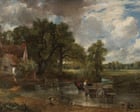
His most elegiac work … The Hay Wain by John Constable, 1821. Photograph: © The National Gallery, London View image in fullscreen His most elegiac work … The Hay Wain by John Constable, 1821. Photograph: © The National Gallery, London John Constable Review The Hay Wain: Walking Constable’s Landscape review – a masterpiece for the climate crisis age Christchurch Mansion, Ipswich While Britain boils in a heatwave, a new exhibition built around the much-reproduced canvas reminds us of the beauty of the natural world – and what we could lose
Jonathan Jones Fri 10 Jul 2026 01.01 CEST Share Prefer the Guardian on Google I first saw John Constable’s 1821 painting The Hay Wain as a postcard with cruise missiles brutally stacked in the wooden cart and pointing at the sky. Peter Kennard’s anti-nuke photomontage is just one of the many parodies and travesties this image of a seemingly eternal rustic Britain keeps provoking. A few months ago, a newspaper cartoon depicted a ballistic missile from Iran speeding through Constable’s painting. But when I visited Ipswich to see its Hay Wain exhibition at the start of the latest heatwave it was the climate making a scorching, ironic comment on this temperate scene.
Inside this Tudor house, grey, blue and brown masses of rain-promising cloud hung above Constable’s painted Suffolk fields, dappling them with shade. But outside the grass was straw yellow and the landscape around Dedham Vale and the River Stour, where Constable was born and in which The Hay Wain and many more of his works lovingly linger, appeared to have been blowtorched into oblivion.
View image in fullscreen John Constable, The Mill Stream, c 1814. Photograph: Colchester and Ipswich Museums Service Global heating may seem to be yet another joke on The Hay Wain’s supposedly comforting, Little English vision, but actually it points the way to a better understanding of a much-stereotyped masterpiece. And it’s liberating just bringing it from its usual home in the National Gallery to Christchurch Mansion (which has a fine collection of Constables as well as works by another local hero, Gainsborough): here you see the painting’s scale and ambition all over again, how it grows naturally out of Constable’s lifelong obsession with the countryside where he grew up.
The show is subtitled Walking Constable’s Landscape but there’s no walking involved unless you take a side trip (well worthwhile) to the local places he painted. Instead, it’s about Constable’s own walks and reveries, recorded in drawings, watercolours and oil sketches that hang around the six-foot-wide main attraction. The earliest item is a piece of graffiti the 16-year-old Constable carved on a beam cut from his father’s windmill at East Bergholt – in which he portrays the mill itself.
View image in fullscreen Flatford Mill from a Lock on the Stour, c 1811. Photograph: John Hammond/Royal Academy of Arts, London Even as a teenager Constable was driven to record, and preserve, his countryside. He was not naive; he knew London and painted its industrial chimneys belching carbon into the atmosphere. His lifetime pretty much encompasses the Industrial Revolution: in other parts of Britain the blast furnaces of Coalbrookdale were illuminating the night, steam was gathering power and Midlands factories were perfecting the production line. He knew all this but preferred to paint, to hold on to, a rural world where people still lived in nature instead of conquering it with machines.