
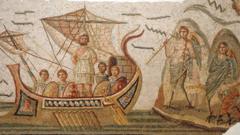
BBC News, Arabic Go to content Main Watch Listen Main Sections News Economy Health and Science Culture and Arts World Cup 2026 Investigations News Economy Health and Science Culture and Arts World Cup 2026 Investigations How do women drive the events of Homer's "Odyssey"? Image credit, Alamy
Homer's epic "Odyssey", dating back about 2800 years, which has recently been adapted for cinematic display, is a work that goes far beyond being just a traditional story of heroism, as the epic's hero, Odysseus, embodies the heroic character, yet the events of the story take shape due to the plans, schemes, and seductions woven by women, nymphs, witches, and goddesses whom the hero encounters during his journey, which gives the story a distinctly human character.
"Odyssey" tells the tale of a legendary Greek soldier named Odysseus who seeks to return to his kingdom Ithaca after years of fighting in the Trojan War, and his perilous journey, spanning ten years, is filled with severe challenges and hardships, a journey that is being screened this month in a new artistic adaptation directed by Christopher Nolan, starring Matt Damon alongside a host of other stars.
Although the central character of the story is a man, the "Odyssey" is a work where women take center stage, as the hero's quest to return to and reclaim his kingdom shapes at every turn by the plans and seductions crafted by women, nymphs, and goddesses who obstruct his path, thus, the "Odyssey" is not a traditional narration of heroic events, but rather a story where gender, strategy, and power intersect, and it still retains its power to influence to this day.
The epic begins at the heart of the action, as Odysseus appears crying on the shore of the island of Ogygia, after spending seven years with the nymph Calypso, and although he has proven his heroism in battle during the Trojan War, he now seems utterly helpless, and this perception deepens as his release from the island is not achieved until a council of the gods convenes.
However, Odysseus is not so much a captive of Calypso as he is a captive of himself, and the contemporary reader is likely to diagnose his state of stagnation, and his inability to move forward and return home, as a symptom of post-traumatic stress disorder, which does not diminish Calypso's power over him, as Odysseus openly acknowledged to the nymph that his wife Penelope cannot match her beauty, as she is merely a mortal woman destined to perish.
Penelope, Odysseus's wife, was not passive throughout her husband's absence, but bravely and cunningly resisted the attempts of 108 suitors who gathered in the palace aiming to marry her and claim the throne of Ithaca as their new kings, and Penelope's weaving of the shroud for her father-in-law Laertes, only to unravel it each night, is among the most memorable scenes of the epic, as she, so to speak, is a moving target, and her success in repelling the suitors is directly tied to Odysseus's ability to reclaim his throne.
A significant indication in the events is that one of Odysseus's main supporters among the gods was the goddess Athena, known for her strategic intelligence, as she aided him in the Trojan War, and was the initiator in urging him to return home, then when the waves cast him onto the land of the Phaeacians, kings of the sea, while he was in a state of weakness, she skillfully devised a plan to save him, as she concealed his weaknesses, enhancing his appearance to make him seem more like a god, worthy of the legendary hospitality for which the Phaeacians are known, which helped him in winning over this seafaring people, who provided him with shelter, treasures, and a safe passage back to Ithaca.
Notably, goddess Athena, in most of the times she appeared to Odysseus and his son Telemachus, took on the form of a man, for instance, impersonating Mentes, a king with friendly ties to Ithaca, and appearing as a messenger to the Phaeacians, and Athena was fully aware that men are the ones who hold power in the human world, whereas women are the ones who guide the course of events through cunning and guile.
It suffices to reflect on the characters Odysseus encounters on his journey, as after reaching the land of the Phaeacians, he began recounting to his royal hosts the encounters he faced, starting from the Lotus Eaters to the one-eyed giant "Cyclops", and it often seems that…