
Science Why Americans Cannot Ignore August’s Total Solar Eclipse By Jamie Carter ,
Forbes contributors publish independent expert analyses and insights. An award-winning reporter writing about stargazing and the night sky. Follow Author Jul 10, 2026, 02:00am EDT Topline The path of totality for the total solar eclipse on Wednesday, Aug. 12, will not cross North America, but Americans still have two big reasons to care about that date: a partial solar eclipse will be visible from parts of the U.S. and Canada, and the same night also brings the annual peak of the Perseid meteor shower. For skywatchers in parts of North America, it could be one of the best astronomy double-headers of the year, with a solar eclipse followed by the year’s best display of shooting stars .
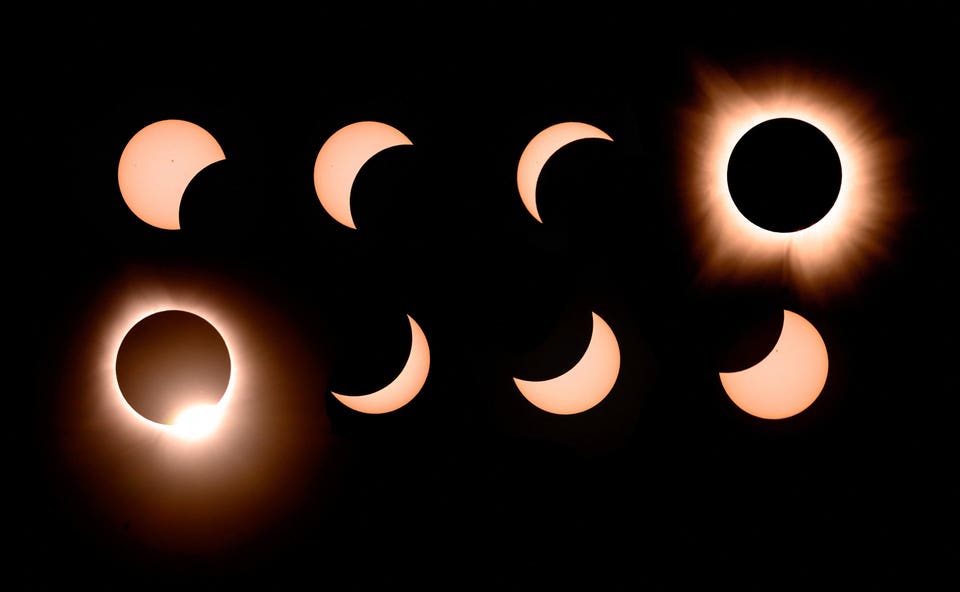
In this composite of eight photographs, the moon passes by the sun into totality and away again during a total solar eclipse in Bloomington, Indiana, on April 8, 2024. This year's path of totality is 115 miles (185 kilometers) wide and home to nearly 32 million Americans, with an additional 150 million living less than 200 miles from the strip. The next total solar eclipse that can be seen from a large part of North America won't come around until 2044. (Photo by JOSH EDELSON / AFP) (Photo by JOSH EDELSON/AFP via Getty Images) AFP via Getty Images Key Facts A total solar eclipse will be seen from a 180-mile-wide path of totality across eastern Greenland, western Iceland and northern Spain, where the moon’s umbral shadow will touch Earth. In those places, day will briefly turn to twilight and, in a clear sky, the sun’s corona will become visible around the moon for up to 2 minutes 18 seconds.
Unlike the April 8, 2024 “Great American Eclipse,” no part of North America will experience totality on Aug. 12, when only the moons fuzzy penumbral shadow will strike. However, millions of people in eastern Canada and the northeastern U.S. will still see the moon take a visible bite out of the sun.
Eclipse glasses that comply with ISO 12312-2 must be used whenever looking directly at the sun. Binoculars, cameras and telescopes also need secure front-mounted solar filters.
The Perseid meteor shower will peak overnight on Aug. 12-13, with the best views expected from Dark Sky Places , Dark-Sky Preserves (Canada), Starlight Reserves and anywhere that looks dark on a light pollution map . The hours after midnight will be favored, when about 50 “shooting stars” per hour may be visible.
A total solar eclipse occurs for somewhere on Earth roughly every 16 months, but at any one place they are very rare, often returning only once every few centuries.
The solar eclipse of Aug. 12, 2026, showing the path of totality (yellow) and wider region of the partial eclipse, which includes parts of North America. Map by eclipse cartographer Michael Zeiler at EclipseAtlas.com. Michael Zeiler/EclipseAtlas.com SOLAR ECLIPSE 2026: WHAT AMERICANS WILL SEE In the U.S., the farther northeast you are, the bigger the partial eclipse you’ll see. Maine gets the deepest eclipse in the contiguous U.S., with Presque Isle seeing about 28% of the sun covered at 1:50 p.m. EDT and Bangor seeing about 23% at 1:53 p.m. EDT. Meanwhile, Boston will see about 16% at 1:55 p.m. EDT, while New York City will see about 10% at 1:54 p.m. EDT. Alaska gets arguably the best U.S. view, with Fairbanks seeing about 37% of the sun covered at 8:27 a.m. AKDT.
The biggest partial eclipse in North America will be seen from far…