
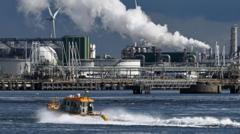
Image source, AFP via Getty Images Image caption, Rotterdam is home to five oil refineries
Standing on a grassy verge in the Hook of Holland, I'm overlooking the Port of Rotterdam.
At the delta of the Rhine and Meuse in the Netherlands, on land largely reclaimed from the North Sea, it's the biggest port for freight, external in Europe.
By some measures, Rotterdam alone handles almost as much cargo as all UK ports combined.
The horizon is dominated by cranes, bulk carriers and container stacks – the visible parts of a vast energy and chemicals hub.
Five refineries, including Shell's largest in Europe, process hundreds of thousands of barrels of crude oil a day, while a tight cluster of chemical plants feeds factories across the continent.
According to research by CE Delft, the fossil fuels flowing through the port are ultimately linked to around 600 megatonnes of CO2 a year – many times more than the CO2 output of the Netherlands' biggest airport, Schiphol.
That scale has made Rotterdam a test case for a difficult question: can a port built on fossil fuels ever truly become green?
Pressure is building on the port to do something.
A lawsuit brought by environmental group Advocates for the Future argues that the Port of Rotterdam Authority is not doing enough to phase out fossil-based energy, and wants a concrete plan to wind down the coal, oil and gas flows whose emissions dwarf those of most countries.
Rotterdam's own industrial cluster currently emits about 29 million tonnes of CO2 a year – roughly half of the Netherlands' domestic emissions, says Mark van Dijk, head of external relations at the Port of Rotterdam Authority.
That's the equivalent of tens of thousands of return flights from Amsterdam to Los Angeles. "It's not good," admits van Dijk.
Image source, Anna Holligan Image caption, The port has plans to cut the emissions of its own activities.
The Port Authority has a plan to cut the emissions of its own activities and encourage businesses on the site to be greener.
It has set targets to cut its own direct and purchased energy emissions by 90% between 2019 and 2030.
The plan includes developing a hydrogen hub where companies can test new fuels, investing in onshore power so ships can plug into the grid instead of burning fuel at berth, and supporting bunkering of alternatives such as LNG, biofuels and methanol.
There is also an effort to mitigate CO2 emissions.
"In the short term we're focusing on CCS [Carbon Capture and Storage] – capturing CO2 and storing it in depleted gas fields," van Dijk says, referring to the Porthos project that will pipe industrial emissions offshore.
Buffeted by the wind, Advocates for the Future director Maikel van Wissen argues that a port of this scale shouldn't just be managing the flow of fossil fuels. Instead, he argues, it has a responsibility to use its clout to speed up the shift to cleaner operations.
"A state-owned enterprise should take legal obligations on states to reduce emissions," Van Wissen says.
"We are asking in the lawsuit to phase out that dependency, to create alternatives. It takes time, but if you don’t have a plan, you always choose cheap short-term solutions. This is an important hub, if you do it in a controlled way, you offer an alternative, that will stop industry from moving elsewhere."