
The former world champion swimmer turned BBC commentator on 5am starts with his mum, a Jaws epiphany, and why he struggled to come out
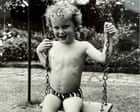
Harriet Gibsone Sun 12 Jul 2026 15.00 CEST Share Prefer the Guardian on Google Mark Foster wearing stripey trunks, sitting on a swing in a park in 1973 Mark Foster in 1973 and 2026. Later photograph: Pål Hansen/The Guardian. Styling: Andie Redman. Archive photograph: courtesy of Mark Foster Born in Billericay, Essex, in 1970, Mark Foster is a former competitive swimmer and winner of 51 major international medals, including six world titles, two Commonwealth Games golds and 11 European titles. He represented the UK at five Olympic Games, and broke eight world records. He works as a commentator for the BBC during major sporting events. Foster’s memoir, My Double Life, is out now.
This was taken in a park in Southend, presumably – as the trunks suggest – near a swimming pool. I would have been with both of my big sisters and my mum. I was always stupidly smiley and never took life seriously.
My house growing up was calm and organised. Mum was the one who did everything at home and Dad went to work. My love of sport comes from Mum – she was the motivation behind my early ambition. Every morning she would get up at 5am, make me breakfast at 5.15am, put me in the car at 5.30am and take me to the pool. Once training was done, she would shuttle me off to school.
It wasn’t until I was six and first saw Jaws that I learned I was fast. Even though I knew Jaws was a fake shark, my imagination went into overdrive every time I got into the pool. I would imagine a series of large pipes linked to the sea and felt it was perfectly feasible for a gigantic killer shark to push through a grate in the bottom of the pool and chase me. While it was traumatic, it did make me a sprinter, and shaped my life as an elite sportsman.
My double life reached a tipping point when I was approaching 50. I thought: am I still contemplating living in secret when I am 80? Aside from being hugely energetic and competitive, I was very naughty – the kid who was always in trouble. It only got worse as I got older. For a long time I thought: if I’m the naughty boy, people aren’t going to notice that I’m also gay. This led to my brief pyromaniac phase. I saw Dad strike a match and thought: that looks like fun. My intention was never to destroy anything; I was just curious and impulsive. But I knew I’d gone too far when I was 10 and set light to a toilet roll at my junior school. The wall caught fire. Thankfully, I could deny that I was responsible. But I realised then it was probably time to stop.
Growing up, every subliminal message I received about being gay was that it was bad. There were no role models who looked or acted like me, and whatever I heard on the TV, or in the playground, was an insult, or negative in some way. I was watching Thunderball with my sisters when I first saw Sean Connery in his trunks. Without really realising it, I said: “He’s good-looking.” My sisters were shocked and told me not to say that. They weren’t being mean, but even as a young kid I realised that the way I felt wasn’t going to be easy to navigate.
When I was 13 I got a scholarship for Millfield – a boarding school in Somerset with a reputation for producing world-class sportsmen and women. All of a sudden I didn’t have the support or the structure that my mum had placed around me. I had to start taking responsibility for my schedule, while also dealin…