
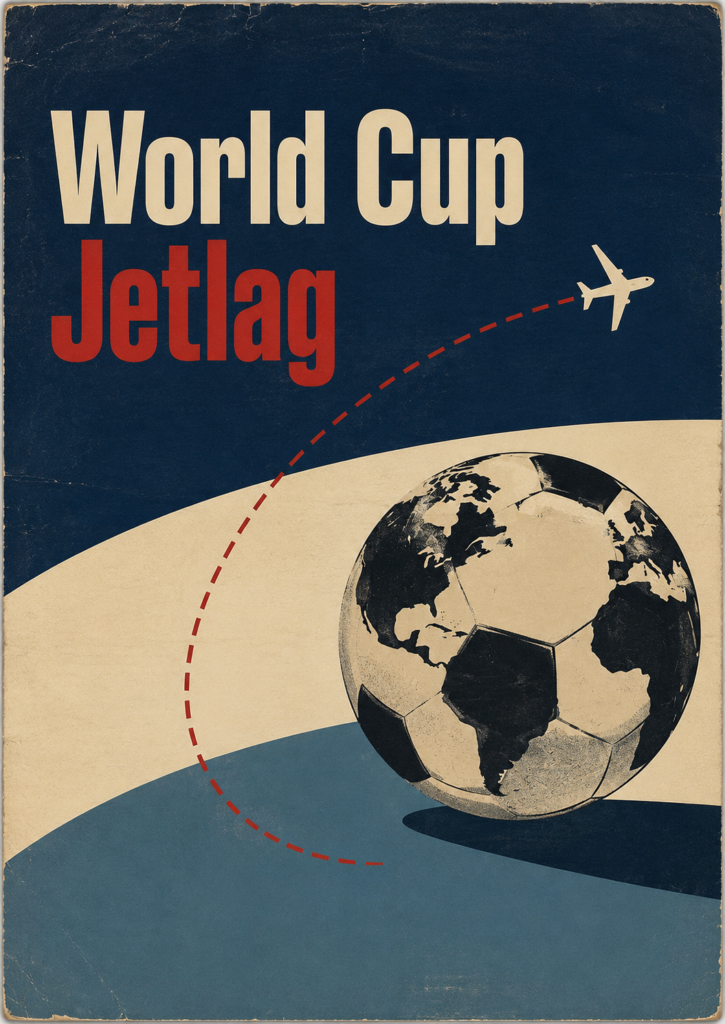
July 12, 2026 July 12, 2026 Home » Cities » Jet Lag of the World Cup The 2026 World Cup has caused significant disruption to global biological rhythms, leading to a widespread case of 'social jet lag' among fans in distant time zones. This phenomenon affects urban infrastructure, as cities are forced to adjust their services and energy consumption to match nighttime activity. These shifts reveal how global media broadcasting schedules can transcend and overwhelm local daily life.
Urban planners usually overlook the city's biological clock, but major sporting events demonstrate how external business interests can manipulate collective behavior. Scheduling matches to align with broadcasting windows in North America forces secondary markets to bear health and economic costs. This highlights the need for urban planning models to take 'temporal urbanism' into account.
How the tournament has changed the biological clock of cities
Before you say that football has nothing to do with urban planning, let me stop you right there.
Without cities, there is no World Cup. Without stadiums, airports, transport networks, hotel areas, and the entire built infrastructure that allows millions of people to gather on one continent, there is no tournament. The 2026 edition is, at its core, one of the largest urban planning projects ever assembled. Architecture came first, and football came later.
That is precisely why what happened to cities during this tournament, and what is happening to the people within them at this moment, is an architectural story.
Researchers tracking the 2026 World Cup developed what they called the 'Fan Sleep Loss Matrix', which measures the overlap between match schedules and the standard sleep window from 11 p.m. to 7 a.m. for fans watching from their home countries. The results were not simple; Algerian fans accumulated 11 hours of lost sleep opportunities during the group stage and Round of 32 alone, making them the most affected fanbase in the tournament.
For Tunisian and Scottish fans in similar time zones, the number reached 7.75 hours over just three matches in the group stage. Fans in Morocco lost 7.5 hours, and in Iraq, 7 hours. These are not minor disruptions. They represent, across a fanbase of millions, a 'collective sleep debt' that accumulates night after night over weeks.
None of these individuals traveled to North America.
They simply adapted their lives to a tournament being played in time zones that are several hours behind their local time, where they watched matches that started after 11 p.m. local time, and sometimes as late as 5 a.m., and then returned to their jobs or schools the next morning.
This is what researchers are now calling 'Social Jet Lag': a disruption of the body's biological clock not through actual travel, but through ongoing behavioral adjustment to an external timetable. The mechanism is exactly the same as traditional jet lag. The body clock expects sleep at predictable hours; when those hours are systematically surpassed due to late match times, or adrenaline from closely scheduled matches, or social commitment to watching live rather than recorded, the physiological result is the same. One survey found that 79 percent of British fans reported that they would sacrifice sleep to watch matches live. Multiply that percentage by the populations of North Africa, the Middle East, and Southern Europe, and you get one of the largest instances of synchronized sleep disruption in recorded history.
The social jet lag of millions of individual fans does not remain inside their bedrooms. It moves across the city.
When a large portion of the city’s population wakes up at 2 a.m. to watch a match, the city responds. Delivery platforms see patterns...