
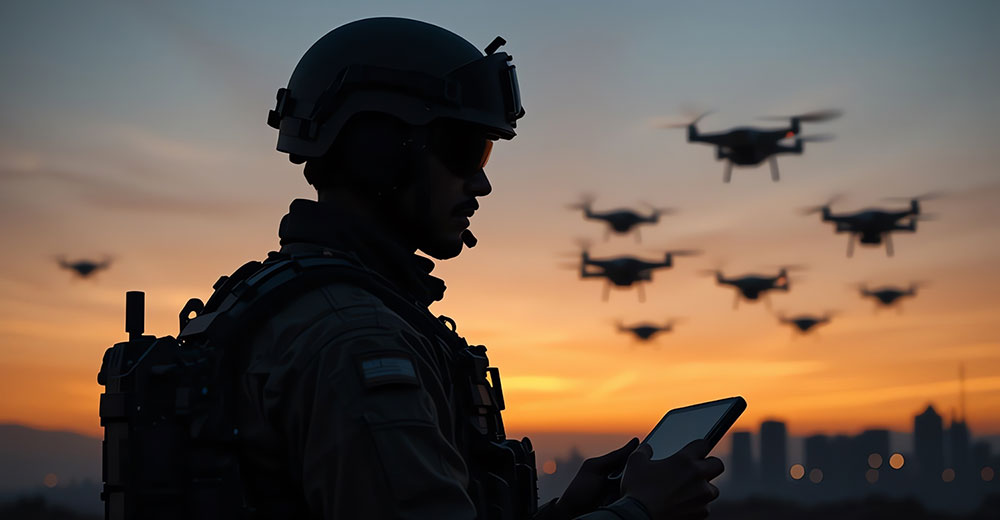
As pervasive computing and specialized hardware become commonplace, the intersection of military technology and artificial intelligence has become a critical issue.
This is no longer science fiction but an engineering reality that threatens to fundamentally alter warfare. Recently, there has been an international push to regulate and prohibit lethal autonomous weapons. The United Nations Secretary-General has advocated for an international law prohibiting machines capable of selecting and engaging targets without human control.
While the moral imperative behind this initiative is entirely understandable, the realities of modern warfare and the nature of software development suggest otherwise. Banning technology that consists largely of algorithmic code and standard microprocessors is an exercise in futility.
Instead of attempting to outlaw the inevitable, the global defense community must focus on building stronger AI defenses to protect against rogue autonomous threats.
Let’s talk about killer robots (I swear too many people watched Terminator and said, “That looks fun, let’s make a killer robot!”). As always, we’ll close with my Product of the Week, the Google Pixel Watch 4, which I just picked up and love.
There is a sound, terrifying basis for why human rights organizations, AI safety advocates, and global leaders want to ban these weapons. When we talk about "killer robots," we are not discussing humanoid terminators wandering a battlefield; we're talking about autonomous soldiers, main battle tanks, deep-sea submarines, stealth warships, and hypersonic aircraft that operate without humans in the decision loop.
The core problem with granting a machine the authority to take a human life is the lack of human empathy, ethical context, and situational judgment.
An autonomous tank programmed to eliminate enemy combatants cannot reliably distinguish between a heavily armed insurgent and a civilian carrying a harmless piece of agricultural equipment that resembles a weapon.
Autonomous submarines operating in contested waters could interpret a civilian research vessel's sonar ping as a hostile act and deploy torpedoes automatically, escalating localized conflicts into major international incidents.
Autonomous aircraft and drone swarms operate at processing speeds far beyond human cognitive limits. If an AI system misidentifies a target, it executes the strike before any human overseer can intervene. The cascading errors of flawed neural networks, biased training data, or enemy sensor spoofing could lead to indiscriminate slaughter.
The UN's concerns are justified; releasing unthinking, feelingless machines to hunt and kill removes the final, crucial barrier to the horrors of war: human conscience.
Despite the valid moral objections, the military incentives to deploy autonomous weapons are too great for warring nations to ignore. We are already seeing these systems prove themselves in the brutal conflict between Ukraine and Russia, which has transformed into a real-time proving ground for next-generation combat technology.
In this war, electronic warfare and signal jamming are ubiquitous. Traditional remotely piloted drones often lose contact with their operators, resulting in high attrition rates.
To counter this, both sides have increasingly turned to autonomous targeting systems. Drones are now being programmed with machine vision algorithms that allow them to identify a Russian tank or a Ukrainian artillery piece, lock onto…