
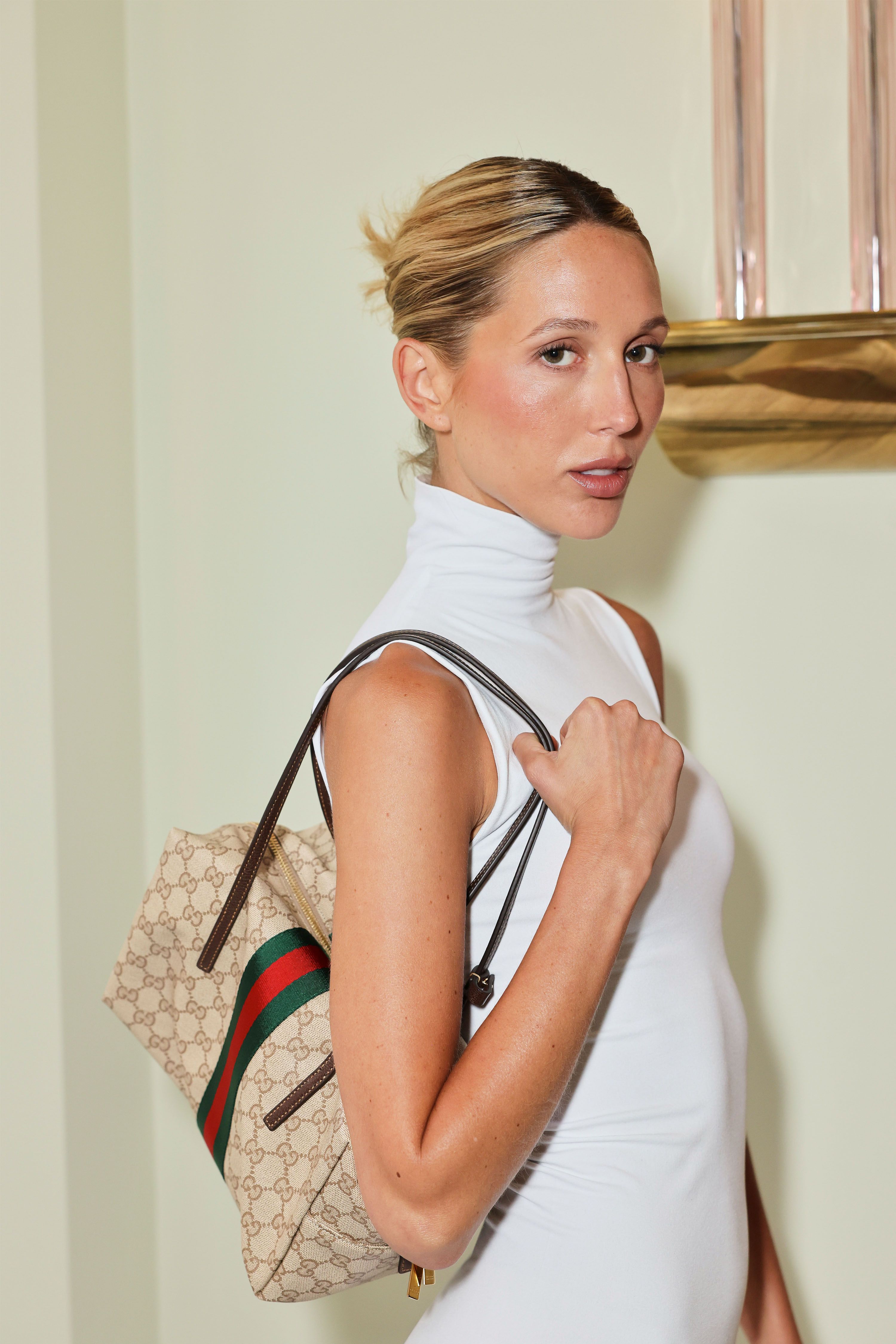
Princess Maria-Olympia of Greece and Denmark attends a private dinner hosted by Gucci. Photo: Getty Images Save Story Save this story Save Story Save this story During the most recent haute couture season in Paris, alongside A-list celebrities and influencers, a new guard was seen lighting up the front rows and slowly conquering the luxury goods kingdom: young aristocrats.
Princess Maria Chiara of Bourbon-Two Sicilies, a descendant of the family that ruled over Southern Italy between 1816 and 1861, was spotted at Iris van Herpen on Tuesday, then posted about the collection on Instagram to her 138,000 followers; Princess Alexandra of Hanover, the only daughter of Princess Caroline of Monaco and Prince Ernst of Hanover, is a fixture at Chanel; Princess Olympia of Greece (who has 310,000 followers on Instagram), linked to the Royal House of Greece and Denmark, is a ubiquitous presence during fashion shows and adjacent parties, having appeared at the shows of Dior and Bvlgari, and more recently of Gucci and Tiffany.
Princess Maria-Olympia of Greece attends the Gucci SS26 show and Eugenia Hanover attends the Valentino Beauty x Colman Domingo house party.
These aristocrats share their silver-spoon lives across social media, where they mix content related to family events and charity projects with appearances at fashion week and high-society outings like Wimbledon, Ascot, and Roland-Garros. They’re definitely not the relatable, girl-next-door influencers that customers flock to online. But while these figures can be controversial in an eat-the-rich, anti-elitism era, in certain circles, they’re the ultimate peddlers of high society. And as competition in the luxury goods arena heats up, particularly in jewelry, where 60% of sales are unbranded, and glorifying the past is the new strategic mantra, brands are rekindling with the descendants of the blue-blooded families who built their glories.
“Luxury sells status, and that’s fast becoming a problem for it, because the kind of status you can buy is now available to anyone with the money, while an aristocrat on the other hand, has the one form of status that isn’t for sale,” observes consumer behavior psychologist Paul Russell. Luxury labels, he argues, seek proximity to aristocrats to benefit from a form of associative learning known as “evaluative conditioning”. According to the principle, we tend to form similar perceptions of two different things when they are seen together, and so a name linked to history bestows its aura on the brand adjacent to it.
Russell points to Dolce & Gabbana’s partnership with Lady Kitty Spencer, a niece of Diana, Princess of Wales. “You’re buying a lineage you couldn’t manufacture yourself, you’re also buying an association with Diana, Princess of Wales, and that’s almost incalculable in terms of prestige,” he says.
London-based jewelry brand Boodles regularly partners with Lady Amelia Windsor (an extended member of the Royal Family with 100,000 followers on Instagram) for the Chelsea Flower Show, which the jeweler sponsors, and, in the past, it also signed Amelia and Eliza Spencer (both with over 100,000 followers on Instagram) as brand ambassadors. Honour Wainwright, Boodle’s marketing director and sixth-generation founding family member, says the brand seeks partners that align in terms of taste and interests.
Lady Amelia Windsor attends the Chelsea Flower Show.
French accessory brand Olympia Le-Tan has collaborated with Princess Maria Chiara on a capsul…