
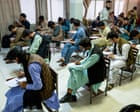
An exam at a private university in Kabul. Photograph: Wakil Kohsar/AFP/Getty View image in fullscreen An exam at a private university in Kabul. Photograph: Wakil Kohsar/AFP/Getty Rights and freedom Taliban The Taliban’s war on education: ‘Nobody talks about what is happening to the boys’ Five years after the ultra-conservative Islamists retook Afghanistan, students describe male pupils being beaten for minor rule breaches and inexperienced teachers struggling to deliver lessons
About this content Fatima Faizi Mon 13 Jul 2026 11.00 CEST Last modified on Mon 13 Jul 2026 14.34 CEST Share Prefer the Guardian on Google B efore he leaves for Kabul University each morning, Hashmat* checks his face for the beard he has been ordered to grow. Male students are required to grow their facial hair and wear traditional Afghan clothes and those who fall short are punished. Hashmat says he recently saw a classmate beaten for wearing trousers.
“They look at you before they listen to you. If your appearance is wrong, you are already in trouble before the class begins,” he says.
Five years after the ultra-conservative Islamists of the Taliban retook Afghanistan , students have described to the Guardian a collapsing education system, with women banned, lecturers leaving and teaching increasingly focused on religious subjects and discipline.
University has lost its purpose. It feels more like a … place where curiosity is banned and remaining silent ordered Qader Students are required to attend religious lectures and pray in public every day, sometimes for two hours at a time, says Hashmat. The lectures are about Islam , conduct and obedience. They are not optional. In some cases, he says, they are held during time that would otherwise be used for regular academic courses.
“I am missing my actual classes to sit in a lecture about obeying. That is what they [the Taliban] think education is for. Everyone talks about the girls who were banned, but nobody talks about what is happening to the boys who were allowed to stay.”
Another student studying in central Afghanistan said the problem is not only weak teaching, but also the disappearance of debate and questioning from the classroom. “We are expected to listen, not to question,” says Qader*. “Since the fall of Kabul, the university has lost its purpose. It feels more like a madrassa now — a place where curiosity is banned and remaining silent ordered.”
View image in fullscreen A booklet on Islamic civilisation that students say they are forced to study. Photograph: Handout Hashmat studies journalism, a subject shaped by digital tools, online platforms, verification, ethics and technology, but as he listens in class, he says he wonders whether the person teaching the course understands the subject well enough to teach it. “He is teaching us about the modern world while struggling to use PowerPoint in the class. How can you teach journalism technology if you do not understand what technology is?”
Hashmat’s account matches those of more than 20 students interviewed by phone at public and private universities in seven provinces across Afghanistan – Kabul, Kandahar, Helmand, Nangarhar, Bamiyan, Balkh and Wardak.
Teachers come to class and read from old notes they cannot explain … it feels like we are back in high school Zalmay Afghanistan’s higher-education sector contracted sharply between 2019 and 2024, according to Unesco , with female enrolment down to zero by 2024 and male enrolment falling from 310,36...