
By Oli Welsh Published Jul 14, 2026, 9:00 PM EDT This John Carpenter movie rivals Jurassic Park in one key respect
Image: New Line Cinema/Everett Collection In the genre of movie moments that is Sam Neill Looking at Something, there is a clear standout. The New Zealand actor, who has died at the age of 78 , and Steven Spielberg created one of the most indelible cinematic images of all time in Jurassic Park when Neill, as paleontologist Dr. Alan Grant, sees living dinosaurs for the first time.
Before showing the audience the dinos, Spielberg shows Neill, mouth agape, eyes transfixed but uncomprehending, sweeping his hat off his head, slowly standing up and then — Neill’s coup de grace — snatching his sunglasses off with trembling, claw-like fingers. Seconds later, in the perfect audience communion Spielberg is famous for, Neill’s amazement becomes our own. The actor effectively authors how the audience feels about the movie. It’s the ultimate example of Spielberg Face .
It says a lot, then, that this shot is run a close second by one filmed a year later for John Carpenter's deranged 1994 horror movie In the Mouth of Madness . In fact, the film has a couple of great examples of Sam Neill Looking at Something. In the first (but not the best) Neill stares directly into the camera, through a tear between one dimension and another — or between reality and fiction, or perhaps between one fiction and another — while a voice narrates the unspeakable horrors he beholds.
Image: New Line Cinema via Everett Collection Carpenter eventually shows us these horrors, but (unlike Spielberg's dinos) they can't quite match the ones we think we see reflected in Neill's eyes. No matter. Unlike Dr. Grant, Neill's character in Mouth of Madness — John Trent, an insurance investigator — hasn't willingly surrendered to the spectacle that’s been arranged for him. He fights it all the way. But in this shot, in Neill’s face, we watch his skepticism, his shield of human arrogance, start to crack in real time.
Trent has been sent by a publishing house to investigate the disappearance of its cash cow, a Stephen King-style horror author named Sutter Cane. Cane’s readers are being sent into a troubling state of hysteria by his books, but they’re selling like hot cakes, and the publisher wants either his next manuscript or a compensatory payout. Trent thinks the whole thing is a marketing ruse, but takes the gig; he believes he has located Hobb’s End, the fictional New England town from Cane's books, and reckons he will find Cane there. He goes, accompanied by Cane’s editor Linda Styles (Julie Carmen). Naturally, Hobb’s End isn't quite what — or, exactly, where — he thinks it is.
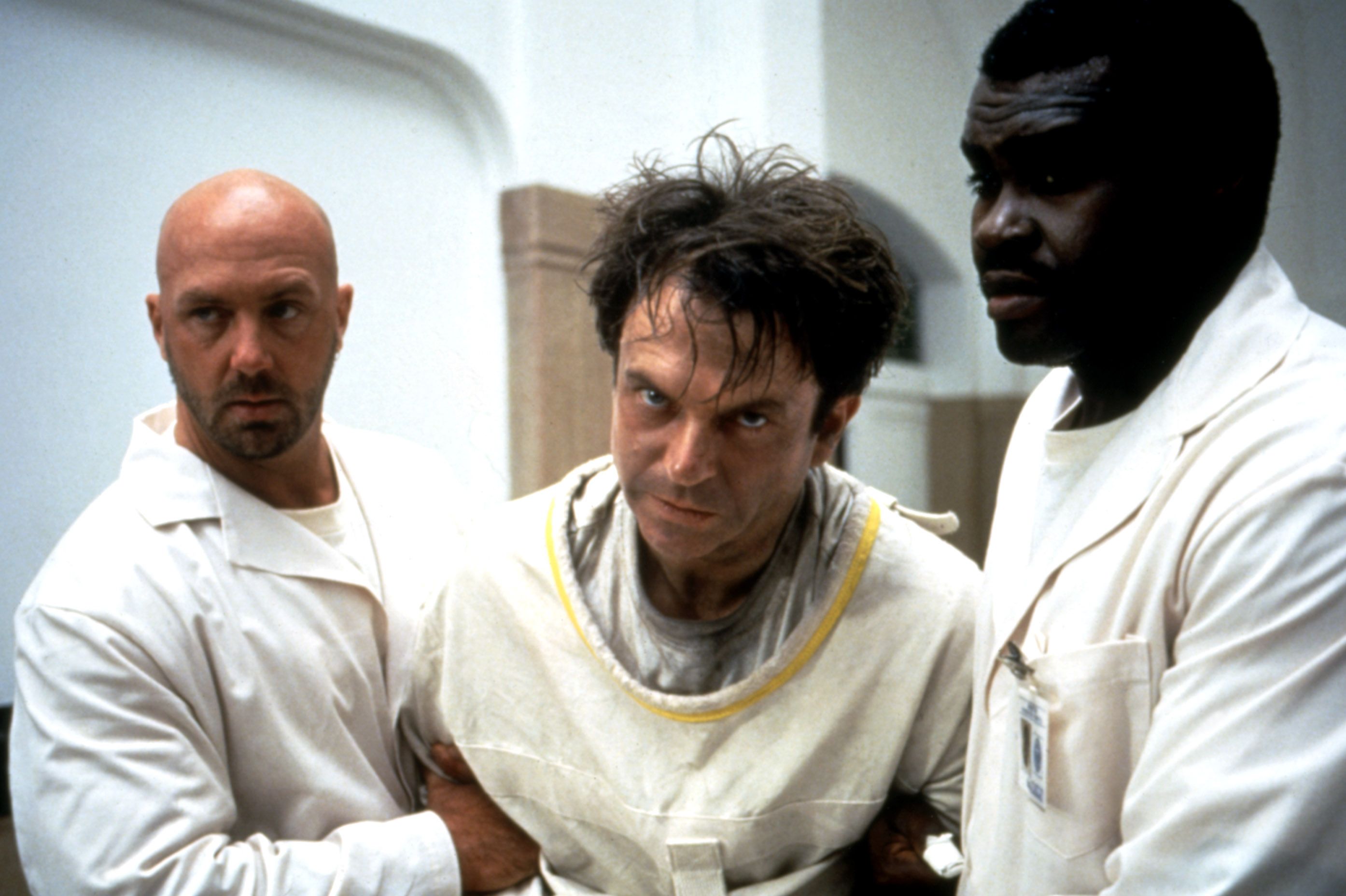
The audience already knows where this is going, because the film starts with a flash-forward showing us Trent being admitted to an insane asylum, bug-eyed and raving, amid dark reports of an epidemic of violence. He tells a visiting examiner what happened on his trip to Hobb's End. But the Trent we meet within his story is cool, smarmy, and cynical, resisting all the horror tropes the movie throws at him: axe murderers, angry mobs, creepy kids, black churches, tentacled things. Neill expertly treads the difficult path of an audience point-of-view character who's quite unlikable, and whose denial of what's right in front of him is essential to the story.
In the Mouth of Madness was written in the late 1980s and brought to Carpenter by Michael De Luca, a studio story editor and horror screenw…