
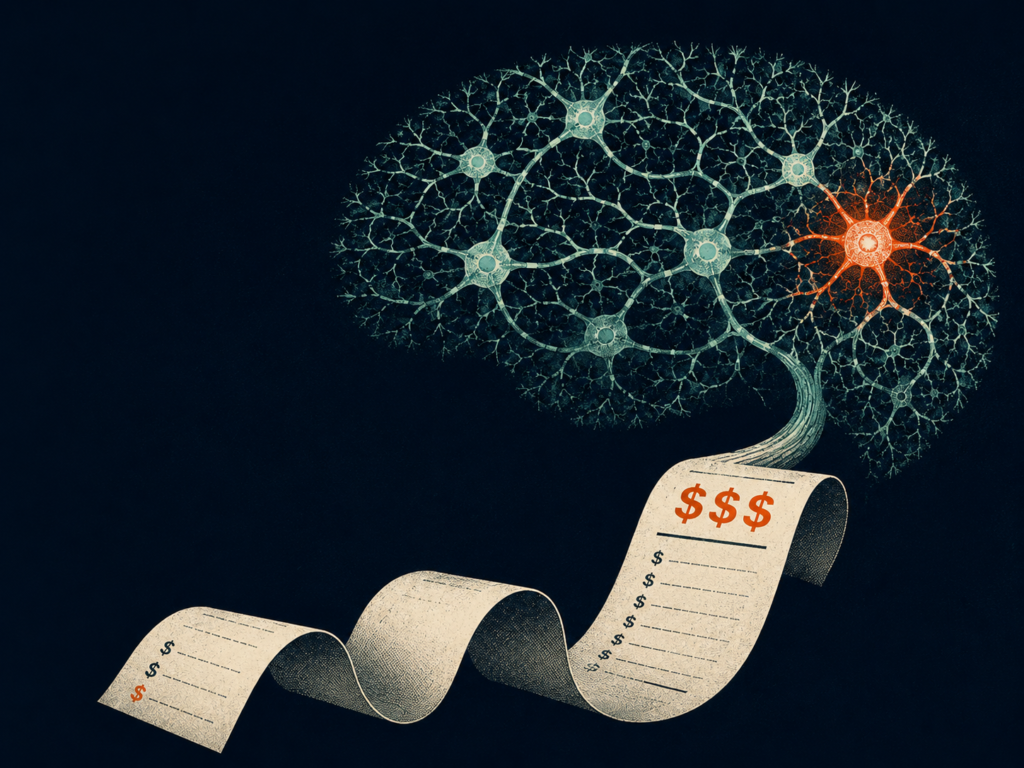
July 15, 2026 July 15, 2026 Home » Architecture Research » Who Pays the Price of Hallucination? AI radically changes the ways professional communication and knowledge production work. Large language models often produce “hallucinations,” which are outputs that appear confident yet are factually incorrect. In architectural showcasing, these errors can manifest as unauthorized changes in structural dimensions or facades, occurring without any warnings from the system or alerts to the user about uncertainty.
Current pricing models charge users for every inference, including failed or inaccurate outputs. This lack of accountability differs from traditional professional standards where service providers bear responsibility for errors. As AI becomes a foundational infrastructure, the industry must establish frameworks that define liability for machine errors to ensure professional sustainability.
I believe that history, twenty or thirty years from now, will not divide the world into before and after the internet.
When I open my email archive from 2020 today, it feels like I’m reading correspondence from another civilization. Not because the language has changed, but because the people behind it have changed.
Email before 2022 was human in a way that is hard to describe accurately until you compare it with what came after. There were typos. Incomplete sentences. Ideas not fully formed before sending. But behind every message, even the poorly written ones, you could feel a person making an effort in real time. The imperfection was evidence of presence.
Today, the message is longer. More organized. More diplomatic. And more polished, sometimes too polished. AI doesn’t just correct text; it adds layers: introductions, transitions, conclusions, and rhetorical framing that the original sender may not have intended and may not even recognize as their own voice. People now routinely send messages that do not resemble them. The machine has added what could be called a “halo” around every idea, a layer of eloquence that amplifies the signal while sometimes obscuring it.
This isn’t a complaint about the quality of writing. It’s an observation about what happens to communication when the tool begins to replace the communicator itself.
If I wanted to describe what has happened to knowledge in the age of AI using one image, I would use “snowball.”
Before large language models, knowledge accumulated slowly. An article here. A book there. A research paper. A project. A conversation. Human understanding built itself through friction, through the effort of assembling pieces that did not always match.
Then came the models. They read everything. Compressed everything. Learned from the totality of human textual output over decades and encoded that learning into weights and parameters that can be queried in seconds.
Then we started using those models daily. Every interaction generated new data. Every correction, every revised prompt, every judgment about which output is better than another, fed back into the system in ways that differ by company and policy but contribute collectively to the ongoing development of the models. The snowball grew. Then we used it again. And it grew again.
This is the closed loop of the current age: AI learns from humanity, then humanity learns to work with AI, then AI is further trained on the results. Each cycle of this loop produces a model that is more capable in some ways than its predecessor.
But “capability” is not synonymous with “accuracy.” And this is where the problem begins.
This term carries a precise technical meaning in AI research: the model generates outputs that seem coherent and confident and contextually appropriate but are factually incorrect or simply fabricated. The model does not know it is wrong. It has no mechanism for knowledge. It produces what is statistically most probable given the inputs, and when its statistical patterns in its training data lead it to a confident error, it adheres to that error with the same fluency it would bring to a correct answer.
In text generation, an informed reader can detect the hallucinations. The citation…