
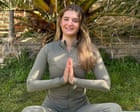
‘The calm, rhythmic movement soothed my frazzled nerves’ … Natasha Livingstone. Photograph: Courtesy of Natasha Livingstone View image in fullscreen ‘The calm, rhythmic movement soothed my frazzled nerves’ … Natasha Livingstone. Photograph: Courtesy of Natasha Livingstone A moment that changed me Yoga A moment that changed me: I started yoga – and saw my scoliosis in a surprising new light As a teenager I declined a painful operation to straighten my spinal curvature, and it was a decision I sometimes regretted. But through daily stretching and exercise, my relationship with my body was transformed
Prefer the Guardian on Google I was 13 when a spinal surgeon gave me unsolicited career advice. “Scoliosis won’t ruin your life,” he said, peering over his spectacles, “unless you want to do bikini modelling.” As a young teenager, I hadn’t thought much about job prospects, let alone modelling, but his words stung. It also curdled my situation into a lose-lose scenario: either have a painful operation to fuse metal rods with my spine, or endure a lifetime with an abnormally twisted back.
Until this point, I’d perceived my spinal curvature in terms of the inward experience: pain. Now, I became aware of an external dimension: a disfigurement. Something to be hidden. This did me no favours as a teenager in the age of Instagram. While I declined the operation due to the risks and the extended leave from school, the surgeon’s blithe remark burdened me with shame.
His approach differed enormously from that of my childhood dance teacher, who had identified my scoliosis. After a lesson, she asked kindly if I experienced discomfort in my hips, which were visibly uneven in my leotard, and suggested I see a doctor.
This led to twice-yearly hospital visits with imposing MRI machines and cold-fingered adults who pressed stickers to my spine. The tests confirmed that my scoliosis was thoracolumbar, referring to a spinal curvature between the chest and lower back . The curve tilted my pelvis, making my hips and legs uneven.
Most noticeably, my right hip was higher than my left, causing my torso to slant sideways like the Leaning Tower of Pisa. This created an hourglass shape on the right of my waist and a straight line on my left.
As I moved through adolescence, scoliosis became the jewel in my crown of insecurities Like eight in 10 cases , the cause of my scoliosis was unknown and could not have been prevented through better posture, exercise or diet. Only an operation could have rectified the spinal curve – and for years I regretted refusing it.
Under loose clothes, my scoliosis isn’t hugely obvious – unless you spot a flash of ankle on my longer leg. Summer shorts and miniskirts are more challenging, as they sit lopsidedly on my hips and thighs. Sadly, bikinis are the worst. Delicate string bottoms slide down the straight side of my waist, requiring a tight, one-sided bow that digs into my flesh and causes the front panel to gape at the middle.
For most of my life, the surgeon’s words rang in my ears every time I tied that bow. Scoliosis did not compare favourably with the filtered silhouettes on social media, nor the symmetrical waists of my friends. As I moved through adolescence, it became the jewel in my crown of insecurities, which led to disordered eating and an unhealthy relationship with my body.
The condition made me different, I believed. Lesser. Unworthy. Instead, I sought validation through academic performance, and by the time my GCS...