
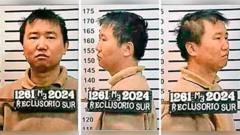
BBC News, Arabic Go to content Main Watch Listen Main Sections News Economy Health and Science Culture and Arts World Cup 2026 Investigations News Economy Health and Science Culture and Arts World Cup 2026 Investigations "Fentanyl King": Who is the Chinese national accused of establishing a drug supply chain from China to Mexico and the United States? Photo credit, Government of Mexico
Enrique, a pseudonym for a man who describes himself as a high-level coordinator in the Mexican Sinaloa cartel, one of the most powerful criminal organizations in the world, says: "Brother Wang was the number one man and had the most influence," before he lets out a laugh suggesting he knows more than he says.
On the outskirts of Culiacán, the capital of Sinaloa state, Enrique sits in a parked car in a spot that ensures no one can hear his conversation, recounting how the raw materials needed to manufacture fentanyl were shipped from factories in China, thousands of kilometers away, to secret labs in Mexico, and insists that cartel members attribute "Brother Wang" with establishing this supply chain.
"Brother Wang" is known in criminal circles as the "Fentanyl King," and according to the U.S. Department of Justice, his real name is Chang Chidong, a 39-year-old Chinese national. He was arrested in Mexico in 2024, but later escaped in what was described as a dramatic operation, before being re-arrested and extradited to the United States in 2025.
Fentanyl is an opioid that is approximately fifty times more potent than heroin and causes the deaths of tens of thousands of people annually, most of whom are in the United States, where this drug often ends up after manufacturing. A dose of just a few grains the size of salt can be sufficient to cause death.
Cartel: A term used for drug and criminal gangs in Mexico.
Former U.S. President Donald Trump described fentanyl traffickers as "drug terrorists" and classified fentanyl and its components as weapons of mass destruction, using the trafficking of the drug as a justification for imposing tariffs on China, Mexico, and Canada.
Photo credit, US Customs and Border Protection via Reuters
When Chang appeared in court in New York in 2025, the then-Deputy U.S. Attorney Todd Blanche described him as one of "the most dangerous drug traffickers in the world."
He was also accused of running "a global criminal network that pumped vast quantities of cocaine, fentanyl, and methamphetamine into the United States, along with laundering "millions of dollars from drug trafficking proceeds."
Chang pleaded not guilty to all charges, and is still awaiting trial, and BBC has reached out to his lawyer, who declined to comment due to ongoing legal proceedings.
Members of the cartel and former associates of Chang agreed to speak with BBC, providing a rare glimpse into how they believe Chang, a graduate of one of China's most prestigious universities, became a key link between chemical manufacturing companies in China and drug labs in Mexico.
Chang graduated from the prestigious Peking University in 2010 with a degree in Spanish, before traveling the following year to Mexico to work for a Chinese company in iron ore extraction, and quickly rose through the ranks to hold a high position.
People who knew him at that time say they saw him as an intelligent, ambitious young man eager to experience life outside his country.
Alex - a pseudonym - who studied at the same university and later worked with Chang at the mining company in Mexico, says that Chang "was skilled in negotiation and had a great ability to find solutions and adapt to different environments."
He adds that Chang spoke fluent Spanish, was adept at using the street colloquial dialect, and had the ability to converse with various people, but retained a clear Beijing accent.
A deep explanation of the main events and topics is worth noting, to help you understand the most important changes around you and their impact on your life.