
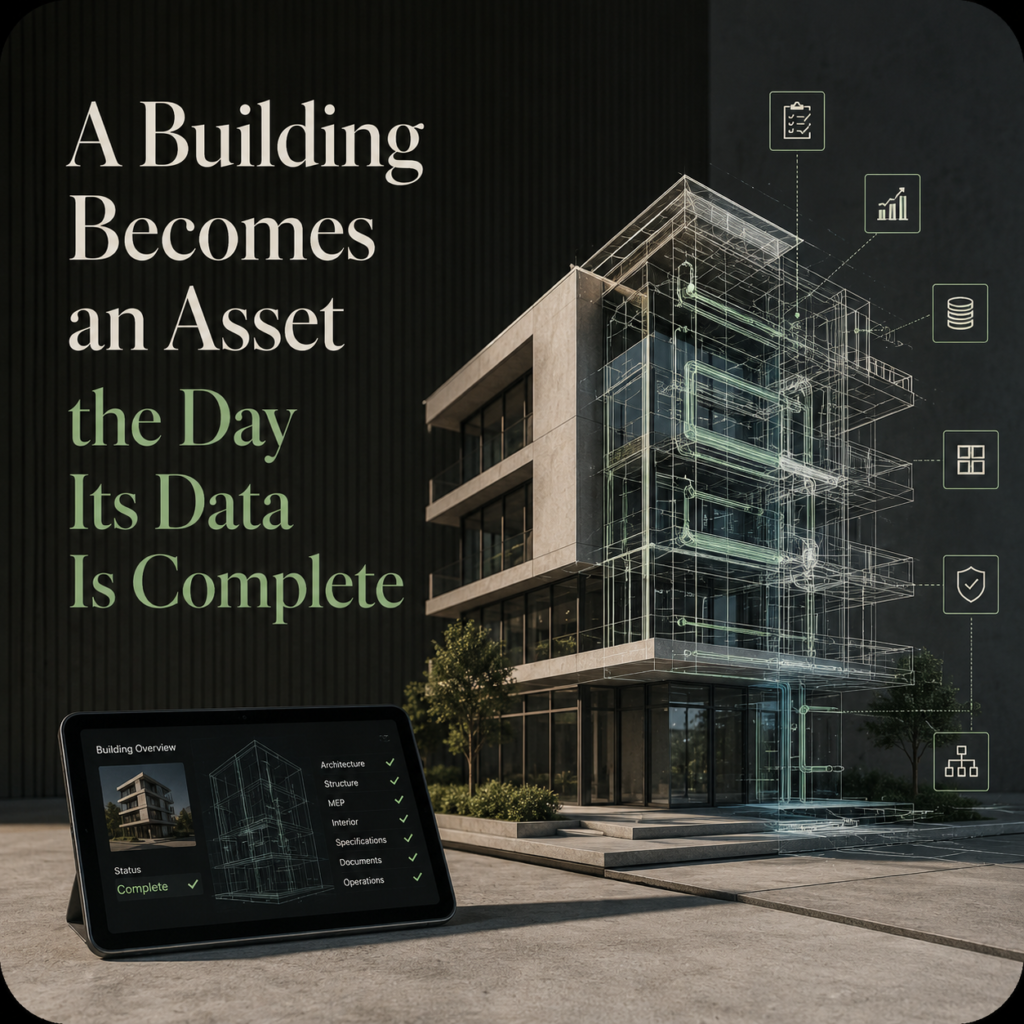
July 16, 2026 July 16, 2026 Home » Architecture Research » The Built Assets The article distinguishes between project delivery and asset delivery, emphasizing that the operational success of the building relies on transferring comprehensive data. While project completion represents the end of construction, asset management begins at delivery. This process requires an organized asset register to manage maintenance, warranties, and life cycle costs.
Effective asset delivery begins during the design phase and not at project closure. Architects, contractors, and owners must collaborate to gather essential information such as room schedules and technical specifications early on. Proper data integration ensures that buildings remain financially sustainable and operationally effective throughout their forty-year lifespan.
The delivery meeting I distinctly remember had everything that any delivery should have. The keys were placed in a small box on the table. The contractor's team printed the plans and stacked them in rolls by the wall. There were signatures, congratulatory remarks, and photographs. Then the facilities manager - a quiet man who hadn’t said a word for two hours - asked one question: which of the four chillers on the roof is still under warranty, and for how long? Silence fell in the room. Someone suggested the information was in one of the rolls. Another thought that the supplier could be contacted. No one knew the answer. The building was complete, but the asset was not complete.
This distinction is the central theme of this article and one that most professionals in the field still refuse to make. We talk about the project as something finished when the construction is done, when the ribbon is cut, and when the certificate is issued. However, in asset management, the calculations go in the opposite direction. The project begins at delivery because everything that defines the economic life of the building starts on that day. Maintenance begins. Warranties begin. Accounting depreciation begins. And facilities management, energy management, replacement planning, remaining life assessment, and capital planning begin. What the owner receives at delivery is not the end of the process; it is the “operating system” for the next forty years. If this operating system arrives incomplete, the building will pay the price for a few weeks of neglect over decades.
There is a name for this confusion. Project delivery and asset delivery are not the same event, even though they typically happen in the same meeting. Project delivery conveys a tangible entity and its legal closure. Meanwhile, asset delivery conveys the knowledge required to operate that entity, maintain it, calculate costs, and plan its replacement. It is entirely possible - and frustratingly common in practice - to receive a completed building that cannot be operated because the data that enable operation was never gathered. International facilities management literature identifies this gap as one of the most persistent causes of operational failure worldwide, and anyone who has inherited a building without its records knows the reason beforehand.
Before moving forward, the word “asset” needs to be properly defined, as the profession tends to use it loosely. According to the ISO 55000 standard, an asset is anything of value to the organization that is managed to deliver that value over its life cycle. This definition is deliberately broad. An asset can be the entire building, a single room, an air handling unit, a pump, an elevator, a door, a panel, a valve, a generator, a piece of furniture, or a complete system comprising all of the above. The standard, first published in 2014 and reviewed in 2024, is built on one idea from start to finish: that the asset is managed across its entire life and not just during its construction. The implications for architecture are immediate: plans describe an entity, while asset management describes a life cycle.
So, what does real asset delivery contain? Most people respond with one word: “plans,” and this answer reveals how the industry still thinks. The central document, in fact, is the asset register, which is an organized record capturing, for each asset in the building: its number, name and type, precise location by building, floor, and room, manufacturer, model, serial number,...