
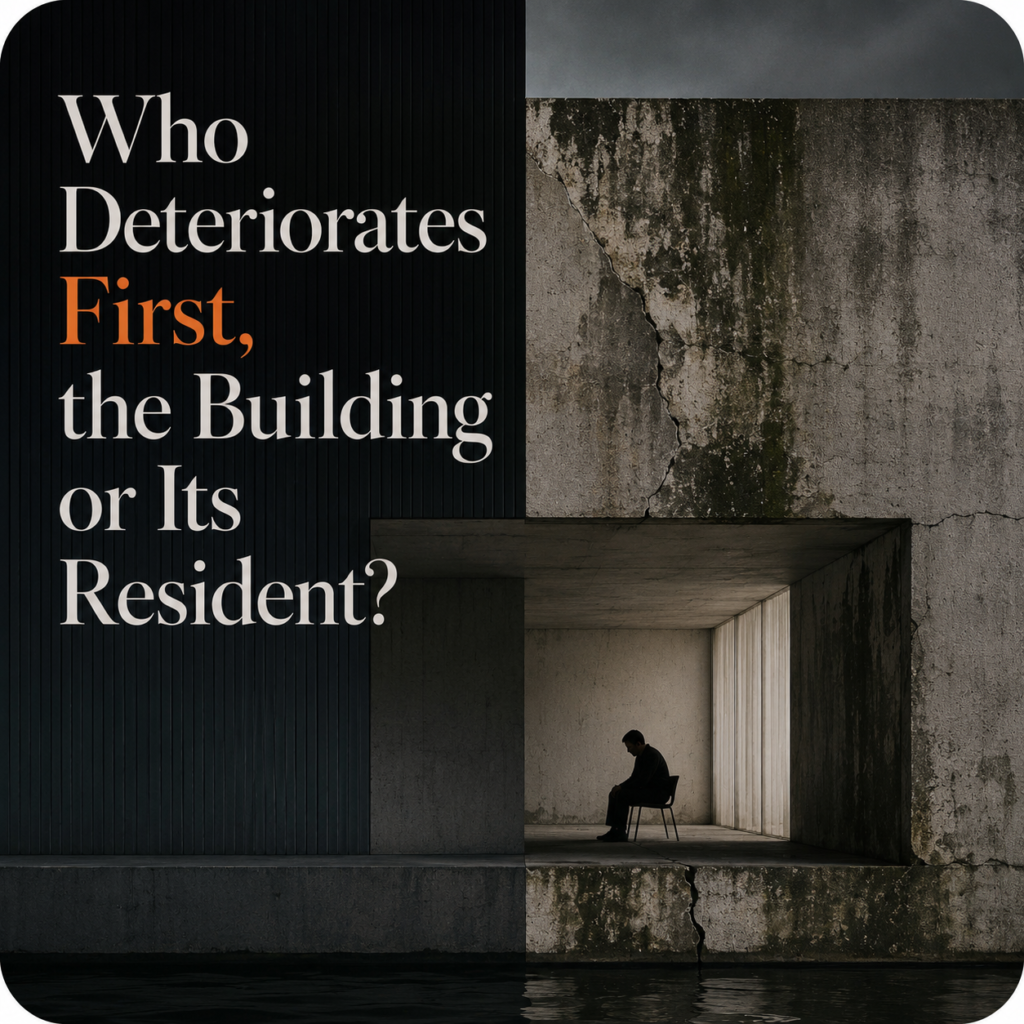
July 15, 2026 July 15, 2026 Home » Architectural Research » Who Decays First, the Building or Its Inhabitant? Residential decay results from a complex interplay of structural failures, intensive usage, and behavioral patterns. While individuals are often blamed, decay usually stems from systemic issues like financial pressure, overcrowding, and housing insecurity. These factors reduce the mental bandwidth required for ongoing maintenance and care of properties.
Ownership of the residence and the individual’s ability to act greatly affect how inhabitants interact with their spaces. Tenants often lack the incentive or authority to make repairs, while shared environments suffer from ambiguities of responsibility. Neglected interiors often represent a feedback loop where economic constraints and imbalances of power lead to a backlog of deferred maintenance.
There’s a question I’ve had for years. Have you ever walked into someone’s home for the first time and felt, within the first five minutes, that you wanted to leave? Not because the apartment was small. Not because the furniture was old. Not because the owner was earning a modest income. But because the place itself declares neglect. You step into the bathroom and feel as if time has stopped there for years. You pass through the kitchen and find that clutter has quietly become part of its design. You look at the walls, the corners, the floors, the doors, and start to understand that the problem isn’t with the building’s age. It’s with the relationship between the person and the place.
Then you enter another home. Smaller, perhaps. Cheaper, certainly. And maybe older. Yet, from the very first moment, you feel a strange calm. Everything settles into its right place. Maintenance is present without being announced. Cleanliness is not a display but a habit. The space seems to breathe. At this point, a different question begins to crystallize. Is caring for the interior space a matter of income? Or culture? Or is it born from the character of the person living inside?
The contours of this question became clear to me during a visit to one of the projects we were studying for potential redevelopment. The building had housed the same tenant for nearly twenty years without a real maintenance program. The first instinct of many colleagues was to demolish. The truth was less dramatic and more profound. The building was not structurally sick. It had been a victim of two decades of accumulated deferral. Its market value decreased, its rental income dropped, and its components wore out faster, while a modest culture of ongoing maintenance would have preserved it at a fraction of the final cost. Standing in its hallway, the real question of this article emerged. Who decays first, the building or the person living inside?
The honest answer, which may be uncomfortable for anyone looking for a villain, is that the evidence rejects the existence of a sole cause. The decay of the internal living environment cannot be explained by poverty alone, nor can it be explained by the vague accusation of tenant culture. Instead, what the research describes is 'interaction.' Financial pressure, poor control over housing, impermanence, overcrowding, ambiguity of responsibility, pre-existing decay in the building itself, and psychological stress all come together to register this combination in the interior design. There is no reliable study that allows us to say that a social class, gender, or profession is inherently less clean or less concerned with space. The built environment is more truthful than that, and more complex.
Before making any judgment, it’s essential to separate three distinct types of decay, because conflating them into one type is exactly what generates erroneous interpretations. The first is structural or service failure. Water leaks, dampness and mold, poor drainage, cracked walls, heating or cooling failures, warped windows and doors, broken tiles due to the building's age or due to poor construction in the first place. These problems typically fall within the responsibility of the owner or building manager and tell us almost nothing about tenant behavior. The tenant did not crack the foundation. The tenant did not choose the cheap membrane that now allows water to leak into the wall.
The second type is decay due to intensive use. Bathrooms and kitchens consume faster than intended, moisture accumulates from too many bodies in too small a space, waste is generated at rates...