
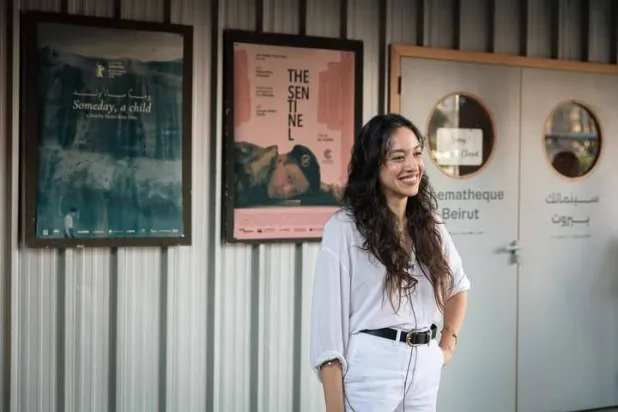
Marie Rose Assaf carries the «Golden Bear» for Best Short Film from the Berlin International Film Festival, after a journey that began with a short film in duration but wide in its impact. With this achievement, «One Day, A Boy» writes its name among the most prominent Lebanese short films that reached one of the highest cinematic platforms in the world.
Months after its crowning in Germany, the film returns to the city it originated from. On the last day of the «20 Years Together» celebration organized by the «Metropolis» cinema, the audience gathered for its first screening in Beirut, filling the hall. The director seemed affected as she met her audience for the first time in her city. She admitted she did not expect the turnout, nor that the film would receive such a reception since its first Beirut showing. The moment carried the significance of its return to its natural environment where its idea was born, before crossing borders and garnering the highest awards.
A team that believed in the story before the world saw it (Metropolis)
While watching «One Day, A Boy», the phrase written by French philosopher Gilles Deleuze about cinema comes to mind when he said it does not think about things, but makes them think within us. The war recedes into the background, even though it does not leave the frame, as the film explores the slower effect of violence, when a person stops living according to their desires, and begins to live according to the expectations of danger.
The work writes a large part of its scenes in sound. Waiting is the first thing the war conveys to people, before it brings them its destruction. While the roar of airplanes paves the way for what is to come, it plants a gap within time where a person lives suspended between now and moments after. Therefore, sound remains the last thing to leave the film.
Marie Rose Assaf employs magical realism in an attempt to grasp a world whose standards have become skewed. Violence increasingly resembles daily life until people stop questioning it. Imagination finds its way into the film from this entrance, freeing reality from its habitualness. At that point, the boy (Khaled Hassan) with supernatural abilities becomes the most realistic character; he is the only one who still sees what others cannot. He alone knows that what is happening cannot become ordinary, no matter how long it lasts.
The film shines when it places its weight in a walnut and an egg, as if the world is read through its smallest units. The walnut reveals two contradictory perceptions of the relationship with things: the hand that sees the break as a way inward, and the hand that reaches it without leaving a scar. The raw egg, on the other hand, restores the right of things not to be predictable. The further meaning remains in what the film refrains from saying.
However, it sometimes takes an additional step toward explanation. It approaches symbolism after it has said enough, losing something of its expansiveness. When an image is left alone, it continues to think after its expiration. However, when it reveals its cards completely, it finishes its work at the limits of the shot.
The problem is not in the clarity of the idea, as clear ideas can create great cinema. The paradox begins when the image already knows what it should convey about itself. At that point, the viewer moves from searching to receiving, after the meaning has determined its direction. They reach the idea without traversing its maze.
Nevertheless, the film remains convinced that cinema has what wars cannot achieve, namely restoring humanity to an eye exhausted by habit. And when destruction returns to being strange again, humanity regains something it lost long ago.
The Metropolis celebration night also witnessed the screening of another Lebanese film that returned from the Cannes festival. In «La Sentinelle» (The Sentinel), selected for the «Critics' Week», director Ali Sherri builds a cinematic world that deals with matter as it deals with humanity. There is not much of a difference between a wall bearing the traces of time, a statue that has lost part of its features, and a body that has spent years learning how to obey.
The film shifts the focus from war to what it leaves behind. Sergeant «LaFlour» (Argentinian actor Nahuel Pérez Biscayart) bears the marks of the military institution more than he bears his uniform. Years of discipline show in his body, in the movement that has lost its spontaneity, and in the fatigue that appears older than the character. The film reaches a moment where authority is less present on the outside and more entrenched within.
The barracks exit with the guardian «LaFlour». It neither remains behind him nor is satisfied to be a place he left.