
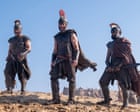
Epic journey … Jimmy Gonzales (Cepheus), Matt Damon (Odysseus ) and Himesh Patel (Eurylochus) in Christopher Nolan’s The Odyssey. Photograph: Melinda Sue Gordon/Universal Pictures View image in fullscreen Epic journey … Jimmy Gonzales (Cepheus), Matt Damon (Odysseus ) and Himesh Patel (Eurylochus) in Christopher Nolan’s The Odyssey. Photograph: Melinda Sue Gordon/Universal Pictures The Odyssey Christopher Nolan’s Odyssey used occupied land as a film set. That feels like a betrayal Mohamed Sleiman Labat The decision to shoot in Moroccan-occupied Western Sahara, where the Indigenous people can’t tell their stories without fear of imprisonment, helps erase our own brutal journey
Peter Bradshaw’s five star review A classicist’s verdict
T he simple act of holding a camera in my homeland of Western Sahara can be a crime. When Sahrawi film-makers and journalists attempt to document everyday life under Moroccan occupation, they can often end up in prison cells. For the Moroccan regime, a camera in the hands of a Sahrawi threatens its official narrative that Western Sahara is part of Morocco.
In contrast, when celebrated international names in the film industry wish to capture an ideal picture for an epic journey, and decide that our land is exotic enough to shoot the desired scenes, they are welcomed, escorted and granted access by the same authorities that usually deny us that right.
This is the bitter and paradoxical reality in Western Sahara, an occupied territory with many material and immaterial riches. While foreign extractors of all kinds freely plunder Western Sahara’s phosphate minerals, sand, fish, and tomatoes, and commodify our winds, sunlight and picturesque desert landscapes, we the Indigenous Sahrawis are becoming a minority in our own homeland, systematically marginalised, silenced and denied access to the land we roamed as nomads for centuries.
The latest episode of this colonial drama stars the Christopher Nolan blockbuster using parts of our occupied territory as a film set. Sahrawis are aghast that scenes from The Odyssey – an adaptation of Homer’s poem immersed in themes of displacement, family separation, betrayal, and the agonising, decades-long struggle to return home – were shot on our lands. The irony would be comical were it not so tragic: we, the Sahrawi people whose land was used to film parts of the Odyssey, have been living our own brutal odyssey for more than 50 years.
View image in fullscreen ‘Audiences coming to see The Odyssey have a right to know about the ethics behind the making of this film’ … Mohamed Sleiman Labat Our homeland suffered a brutal military invasion from the north and south in 1975, when Spanish colonial authorities handed over the territory to Morocco and Mauritania. Today, half of our people languish in refugee camps in the Algerian desert, while the other half lives under a suffocating military police state, separated by a 2,700km militarised wall built by Morocco and fortified with millions of landmines.
Such realities and stories will not make it to the big screen. In a world lured to fiction by the magic of the cinema, it seems easier to “excavate” a 3,000-year-old story of suffering, separation and betrayal than to see that today, those exact themes are daily lived realities by the Sahrawi people.
Nolan’s choice to film in an occupied territory highlights the extractivist practices embedded in the western film industry. Western cinema has often been complicit in mining stories…