
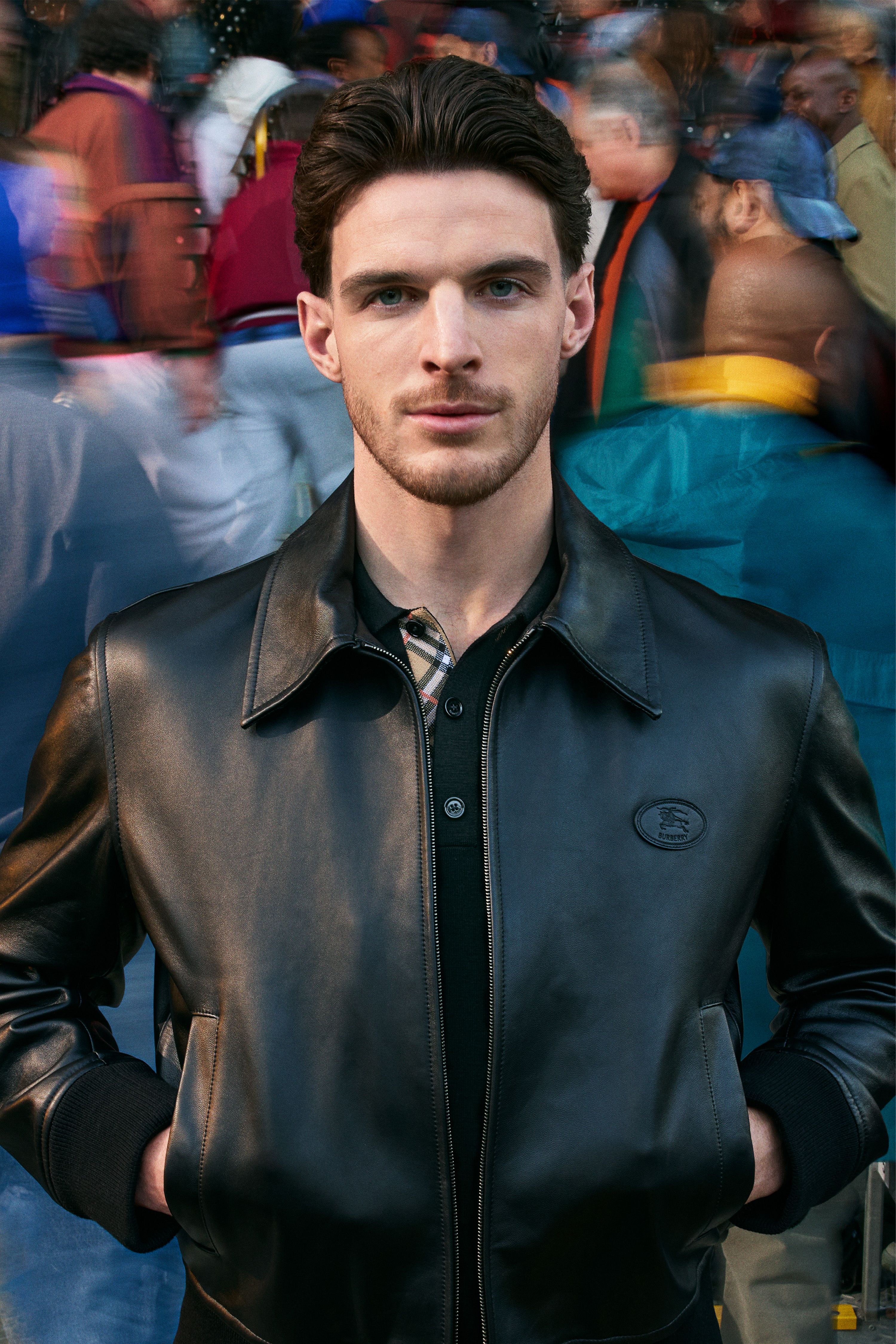
Burberry’s A Good Sport homed in on England players Declan Rice, Eberechi Eze, and Leah Williamson, as well as international talents. Photo: Declan Rice by Mario Sorrenti. Courtesy of Burberry. Save Story Save this story Save Story Save this story On July 19, the most-watched competition in global branding will come to a close, along with the Fifa World Cup itself. At halftime on the field of play at the New York New Jersey Stadium, megawatt stars including Madonna, Shakira, BTS, Burna Boy, and Justin Bieber will take to the stage, co-signing a handful of designers. Behind the frenzy, fashion and sportswear labels will begin a wash-up on the success of their campaigns — some years in the making — analyzing everything from views, impressions, and consumer sentiment to hard-to-predict factors, such as star-player impact and team wins.
For competition favorites, Nike and Adidas, return on investment will be scrutinized in micro-detail, guiding their approaches to future marketing in both sportswear and broader lifestyle categories. Adidas reportedly spent $67 million on its hero film, Backyard Legends , while Nike also splashed heavily on talent — Kim Kardashian, Kylian Mbappé, Central Cee, and LeBron James, among others — for its competing short, Rip the Script .
Meanwhile, Burberry unveiled a hyper-British, globally resonant campaign, A Good Sport , leaning on a cast of national and international names. Reformation joined forces with Umbro for a capsule of chic spectator separates. And Levi's outsmarted Fifa’s advertising bans for non-partners by posting its covered-up stadium logo on Instagram with a sassy, clapback caption, “Welcoming the world to the beautiful [redacted] stadium!” The post drew a record number of comments and shares for Levi’s.
Per Fifa’s data, more than 50 million people across Mexico, Canada, and the USA watched the World Cup unfold during its opening weekend. Since then, record-breaking stats have come thick and fast. Kylian Mbappé achieved a sprint speed of 37.6 km/h. Jude Bellingham, 23, became the youngest soccer player ever to play in 10 World Cup matches. And almost half of Portugal watched the country’s match against DR Congo. With the rise in second-screen watching and secondary content — such as reactions, predictions, commentary, and styling formats — before and after the matches, the opportunity for brands has been enormous.
According to Launchmetrics, the competition’s buildup — April 1 to June 10 — had a total media impact value (MIV) of $5.6 billion, with Europe taking the lion’s share ($1.5 billion), followed by North America ($1.4 billion), Asia ($1.1 billion), South America ($989.5 million), and the Middle East ($340.7 million). For context, this year’s NBA Finals generated a $1.6 billion MIV, Roland-Garros hit $678 million, and the Monaco Grand Prix reached $403 million. Depop also recorded a surge in searches for “world cup jersey” (+1,155%) and “soccer jerseys” (+954%) in the May-to-June period.
An underlying shift has also been identified by marketing executives. The World Cup is no longer a standalone event in the cultural calendar, but also an opportunity for more long-lasting impact on the brand marketing playbook, requiring mapped-out, multi-pronged campaigns and the bandwidth to react in real time.
Saint West and Kim Kardashian appear in Nike’s Rip the Script campaign. Nike’s global soccer category grew double digits in each of its key geographies in Q4.
So, who actually won? It…