
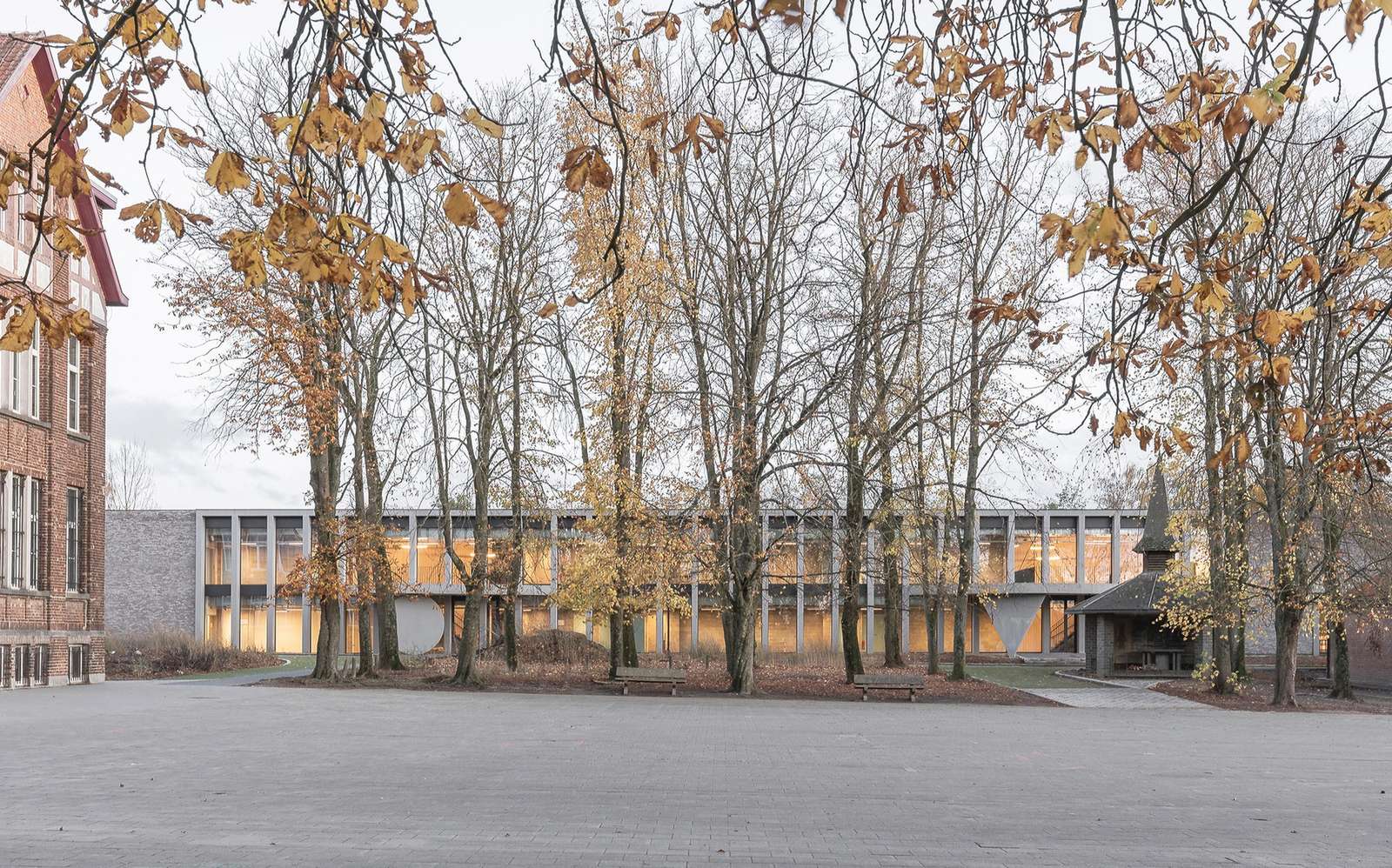
July 17, 2026 July 17, 2026 Home » Projects » Cardinal Mercier College Building Presents a Modern Approach to Architectural Resilience and Sustainability. A contextual extension in contemporary language, the new building at Cardinal Mercier College is an architectural response that respects the unique character of the dense wooded site, completing the identity of the existing campus wings without resorting to direct imitation. The design relies on simplifying the materials palette to find a balance between harmony with the context and highlighting an independent contemporary architectural identity. The architectural mass reflects a trend that integrates site requirements with environmental efficiency goals, transforming design constraints into solutions that support functional performance and energy consumption reduction.
The spatial experience begins at the moment of approaching the building through the surrounding natural spaces, then progresses to the interior through a clear organization of movement pathways and the sequence of spaces. The façades respond to the sun's path, producing continuous changes in light and shadow that add visual variety to both interior and exterior surfaces. The use of natural light and ventilation enhances a comfortable interior environment, establishing visual and functional connections between educational spaces and the natural surroundings, a trend evident in many contemporary architectural projects.
The project relies on selecting materials characterized by durability and long operational life, enhancing the building's stability within its context while maintaining its ability to meet future needs. The interior spaces are divided into flexible functional zones, supported by a structural framework and technical systems that allow for reconfiguring spaces as needed without substantial structural interventions, enhancing the building's adaptability to changing uses over time. Data sheets for the materials can also be referenced to understand the properties of materials used in such projects.
The building's environmental performance is based on design strategies that help regulate the indoor climate by minimizing heat loss in winter and reducing heat gain during summer, thereby enhancing energy efficiency and user comfort. The interaction of masses and openings with natural light creates continuous changes in lighting and shadows, granting the spaces visual variety that reflects the integration of environmental performance with architectural composition.
The project does not view the campus expansion as a mere formal extension of existing buildings but redefines it through precise alignment between environmental performance, material efficiency, and functional flexibility. Its architectural value comes from transforming integration with the context into a measurable operational criterion, rather than merely settling for visual imitation, placing it within contemporary discussions on architecture and the sustainability of building materials.
However, the discourse assumes that adaptability alone is sufficient to ensure the building's long-term sustainability. Spatial flexibility and the efficiency of the exterior envelope are not enough if educational models or operational and maintenance priorities change. At that point, environmental performance efficiency may become less impactful than the institution's ability to manage operational transitions that redefine the actual value of architecture over time, a topic that recurs in many architectural studies.