
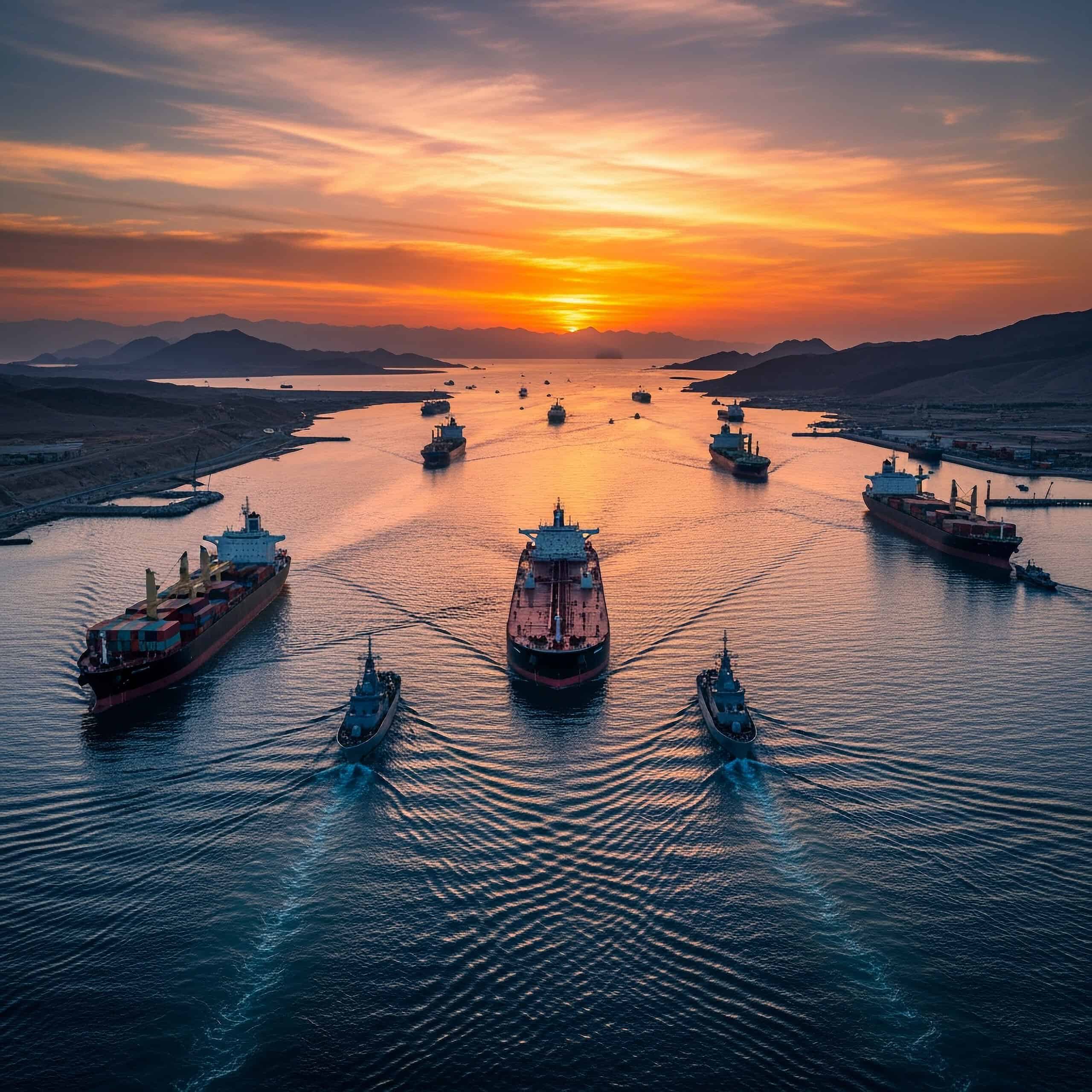
The race is on to secure alternative routes for both Gulf fossil fuels and clean energy.
This article appears in the July/August 2026 issue of Global Finance Magazine.
More than 30 years after the first Gulf War, it seemed unlikely, if not unthinkable, that images of burning oil facilities would once again make headlines in the Middle East.
Yet here we are again. And once again, the region’s energy producers must figure out how to pick up the pieces.
“It’s like Pandora’s box is open or the genie is out, but can it really be put back?” said Laury Haytayan, an energy expert and MENA director at the Natural Resource Governance Institute (NRGI), a U.S.-based nonprofit. “Gulf countries think this event could happen again, and if it does, they never want to find themselves in the same position, so they need an alternative. Now, what sort of infrastructure should they invest in? Big pipelines? Road projects? Other alternatives? Everything is on the table.”
In March, the conflict among the U.S., Israel, and Iran escalated into a regional crisis. Tehran retaliated against Gulf Cooperation Council (GCC) states and blocked the Strait of Hormuz, the narrow waterway through which roughly a fifth of the world’s oil and large volumes of liquefied natural gas (LNG) transit each day. The disruption pushed Brent Crude above $100 a barrel and sent shockwaves through global markets.
For Persian Gulf states whose economies depend heavily on hydrocarbon exports, the consequences have been unprecedented.
Damaged infrastructure and lower export revenues have weighed on growth, though the impact varies across the sub-region. According to the International Monetary Fund’s April projections, Qatar’s economy is expected to contract by 8.6%, while Kuwait and Bahrain are expected to contract by 0.6% and 0.5%, respectively. Oman, Saudi Arabia, and the United Arab Emirates (UAE) are expected to prove more resilient, with projected GDP growth of 3.6%, 3.1%, and 3.1%, respectively.
“Saudi Arabia, Oman, and the UAE were best prepared because they have an alternative to bypass Hormuz,” Haytayan notes. “The others are largely unable to export hydrocarbons and their byproducts.”
The conflict has affected adjacent industries, including mining, petrochemicals, and metals. The knock-on effects are already visible in global agriculture and food systems, where fertilizer supply chains are heavily dependent on natural gas.
The GCC, led by Saudi Arabia and Qatar, accounts for roughly 25% to 30% of global exports of ammonia, urea, phosphate, and sulfur, key inputs for nitrogen-based plant boosters. Production constraints and logistical bottlenecks have tightened supply and pushed prices higher. Regional manufacturers such as QAFCO and SABIC may benefit from stronger margins in the short term, but prolonged shortages could lead to food insecurity in import-dependent countries.
The aluminum sector has also been hit hard. Smelters, including EGA in the UAE, Qatalum in Qatar, and Alba in Bahrain, have sustained physical damage. In April, the International Aluminum Institute reported that regional output had fallen to about 11,000 tons per day, a 40% decline from pre-war levels. Although the Gulf accounts for only 8% of global output, it supplies 18% of European imports and 21% of U.S. imports.
Much like elsewhere in the world, the discussion in the Gulf revolves around a single question: How to avoid Hormuz?
For now, much of Gulf trade has been rerouted to the ports…