
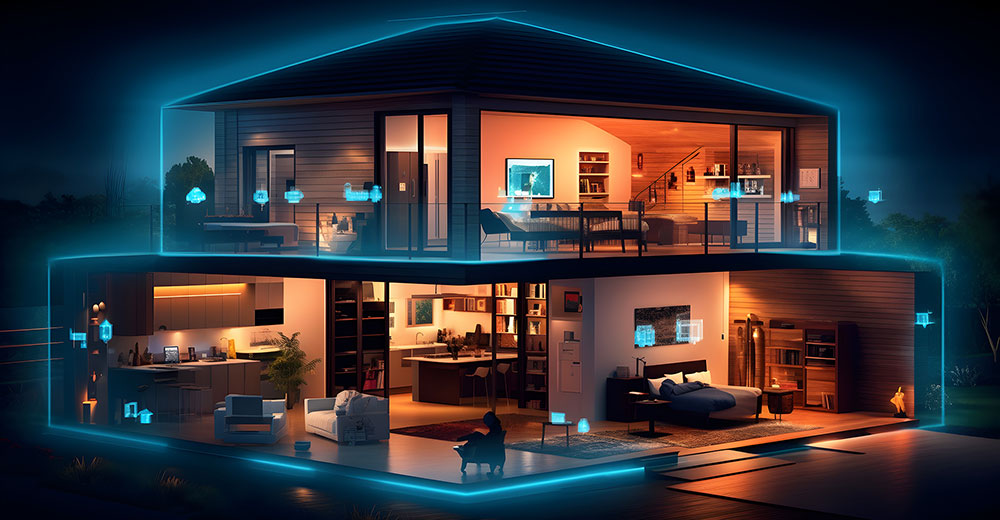
Smart home technology has changed how homeowners monitor security, manage energy use, and automate everyday tasks. Yet one of the most critical safety systems in the home — the smoke alarm — often receives far less attention than cameras, smart locks, or video doorbells.
Smoke alarms have also evolved well beyond the standalone devices many homeowners installed years ago. Modern systems can communicate with one another, send alerts to smartphones, and integrate with broader smart home platforms, extending fire detection beyond the traditional alarm siren. Understanding these capabilities is becoming an important part of evaluating a home's broader safety systems.
Prevention is only one part of home safety. Detection determines how quickly occupants become aware that a dangerous situation is developing and can begin to respond.
This is where early warning systems play a critical role. A properly functioning smoke detector is designed to detect smoke early enough to alert occupants before conditions worsen, providing additional time to evacuate and contact emergency services.
The effectiveness of a smoke alarm system depends on more than simply having detectors installed. Battery maintenance, device placement, alarm age, and whether individual units can communicate with one another can all affect how well a warning reaches occupants throughout a home.
Traditional smoke alarms largely operate as local warning devices: They detect smoke and sound a siren. Connected models retain that core function while adding communication, remote monitoring, and integration capabilities.
Smart smoke detectors can connect to mobile apps, communicate with other devices, and provide alerts when homeowners are away. The key difference is that awareness is no longer limited to whether someone is close enough to hear a siren; connected systems can extend notifications beyond the physical boundaries of the home.
Wireless interconnection addresses a fundamental limitation of standalone alarms: the device detecting smoke may not be the device closest to the people who need to hear the warning.
With standalone alarms, a detector in a basement, garage, or distant room may sound while occupants are elsewhere in the home. Interconnected systems relay the alarm across multiple detectors so that when one unit detects smoke, the connected alarms activate together.
The U.S. Consumer Product Safety Commission (CPSC) recommends smoke alarms on every level of a home and inside each bedroom. The agency also advises that interconnected alarms are best because when one sounds, they all sound.
The X-SENSE XS0B-MR smart smoke detector is an example of how modern fire protection technology has evolved to address these concerns. Designed for connected homes, the detector supports wireless interconnection through a dedicated base station, helping ensure that alerts reach occupants throughout the property.
Interconnection becomes particularly relevant in larger or multi-level homes, where distance, closed doors, and separate sleeping areas can make an alarm in another part of the home harder to hear.
Traditional smoke alarms are designed to warn people at the property; connected alarms can also reach homeowners who are elsewhere.
The XS0B-MR connects through 2.4 GHz Wi-Fi to a mobile app that lets homeowners monitor device status and receive smartphone notifications. For homeowners at work or traveling, those alerts extend awareness beyond the range of the alarm's siren.