
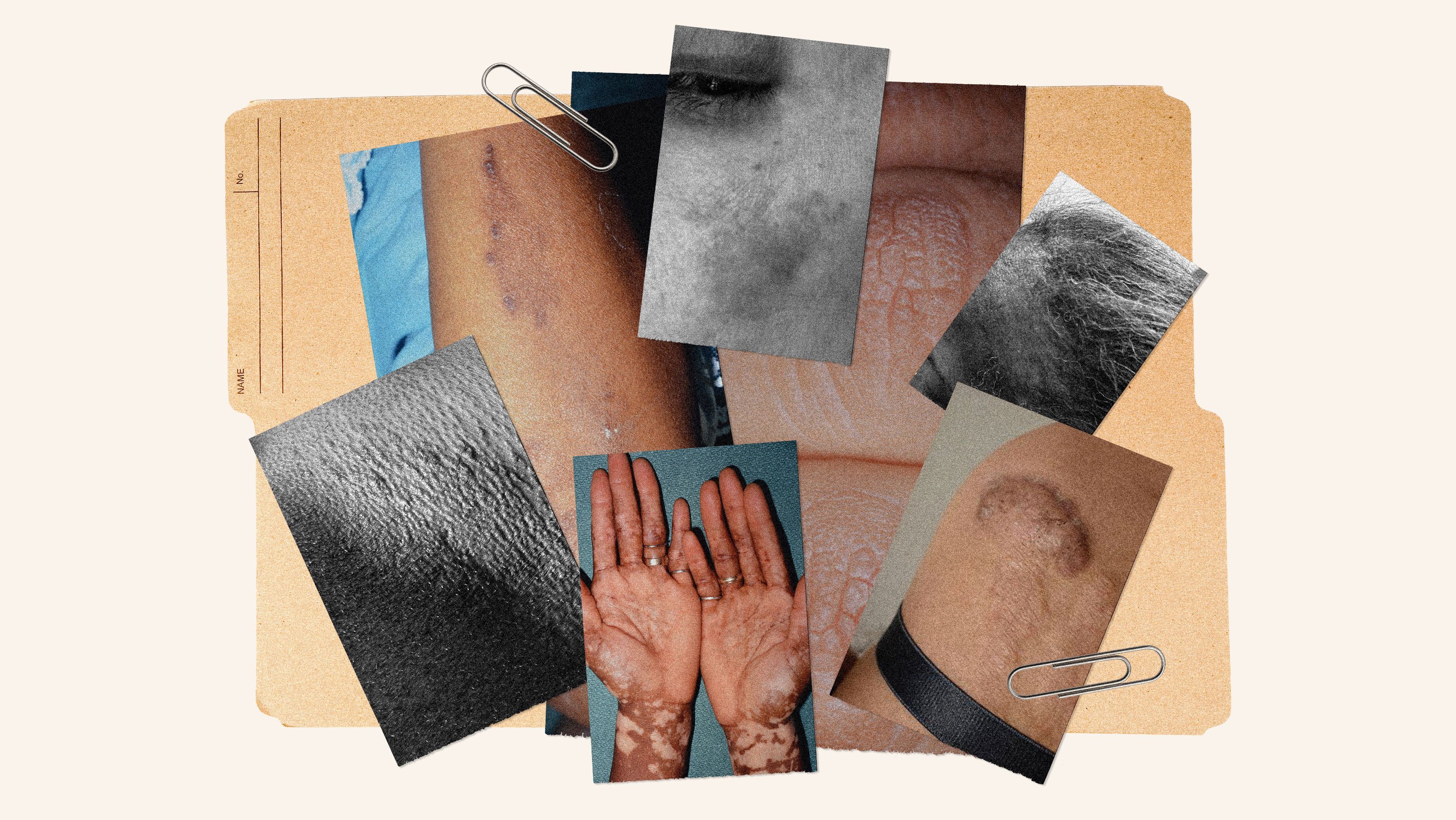
Illustration by Mark Baker-Sanchez; Photos courtesy of AAD; Adobe Stock Save Story Save this story Save Story Save this story Have you ever noticed an unusual bump, spot, or scar on your skin and run it by a search engine, only to be met with a bunch of pictures that don't match your skin tone? Many Black and Brown folk know this experience all too well. Often, the lack of representation of skin conditions on our complexions can leave us feeling even more confused as we try to figure out what's going on.
There's an array of conditions that affect every skin tone, but many of these look different on melanated skin than on white skin. A handful of these skin issues also affect Black and Brown skin disproportionately. A 2025 medical article from the Journal of European Academy of Dermatology and Venereology states that “conditions like post-inflammatory hyperpigmentation and melasma are more prevalent and often more severe in individuals with skin of color.”
This is even more reason why darker skin, in all its glory, should receive the care and attention it deserves in dermatology. In 2004, Susan C. Taylor , MD, a board-certified dermatologist in Philadelphia, established the Skin of Color Society , an organization committed to educating providers and the general public on dermatologic health related to skin of color. Dr. Taylor notes that as the nation's population becomes more ethnically diverse, the dermatological community will continue to see and treat skin conditions that occur more often, present differently, or are unique to Black people and other people of color.
"Since [establishing the Skin of Color Society], we have made terrific inroads in terms of understanding skin of color a little bit better and prioritizing skin of color," says Dr. Taylor, adding that the collective endeavor has led to lectures and conferences centered around melanated skin and more representation in mainstream dermatology textbooks.
To further increase awareness and resources around caring for skin of color, we've created a guide to the most common conditions for those with darker skin—breaking down exactly what you need to know to identify and treat them.
Before we talk about how to properly treat melanin-rich skin, it's important to know exactly what melanin is. Melanin is the pigment that causes your skin color. There are two types of melanin: eumelanin (brown pigment) and pheomelanin (yellow pigment).
A quick search of the hashtags #melanin and #melaninqueen on Instagram validates that the term "melanin-rich skin" has become mostly associated with darker skin tones. But Jenna Lester , MD, a board-certified dermatologist based in San Francisco, says most people have some sort of balance of the two types of melanin.
Depending on a person's skin color, they may have more of one type than the other. In general, eumelanin is more prevalent in people with darker skin. "So it's not that people with dark skin have more melanin; they just have more of a different type of melanin," says Dr. Lester.
Melanin is produced in cells called melanocytes , which are present in the lower layer of the skin, says Dr. Taylor. After making melanin, the melanocytes put it into packages called melanosomes, which are then transferred into the skin cells. In addition to providing pigmentation, melanin also serves as a protective agent. For example, eumelanin protects you to some extent from burning when exposed to the sun, says Dr…