
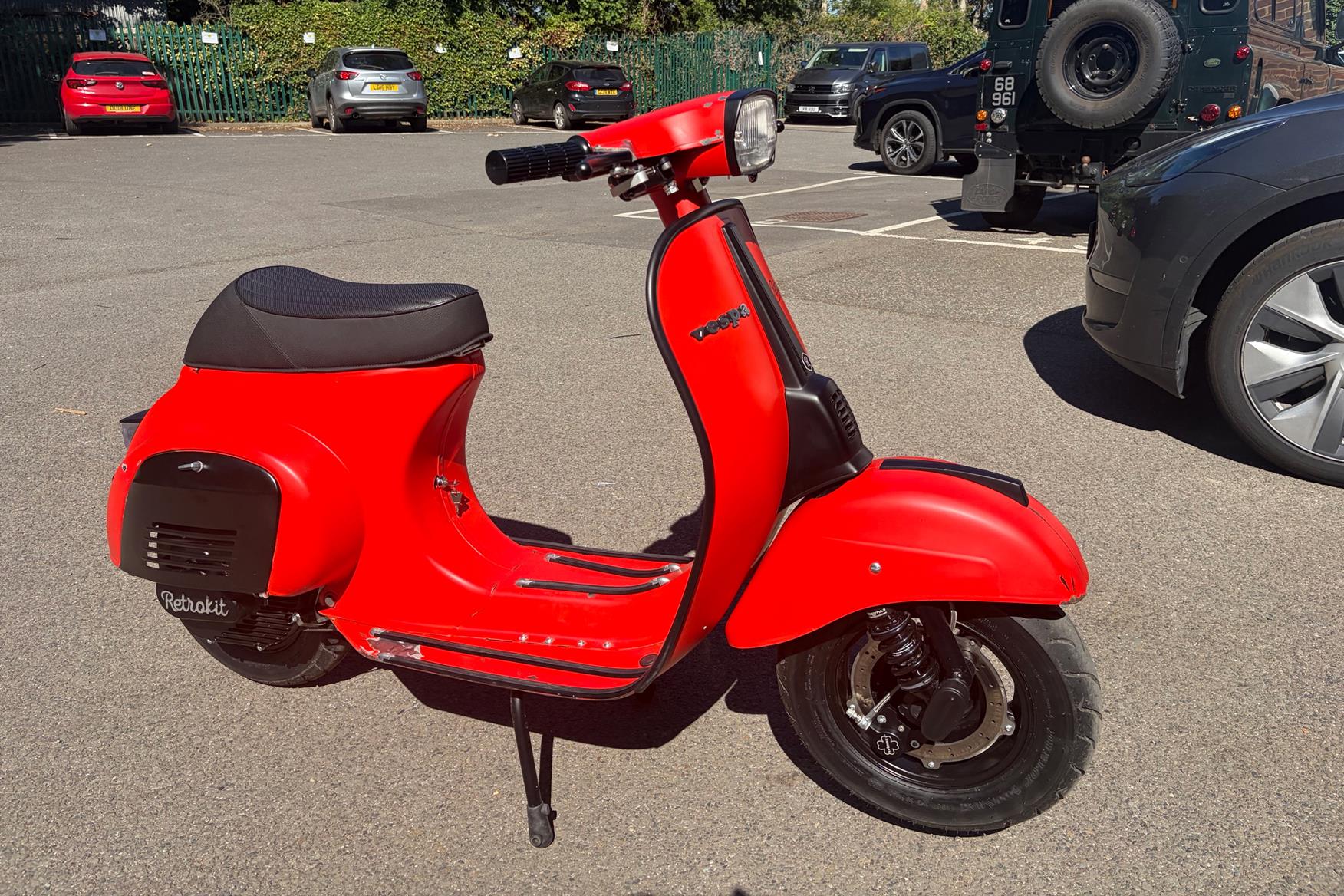
Classic Vespa owners can now convert their scooters to electric power without touching the bodywork, thanks to a new, road-legal retrofit kit available in the UK.
Electric Car Converts have become the UK supplier for the Italian-made Retrokit system, fitting the conversions in-house. The two men behind it are petrolheads first: CEO and Head of Engineering Toby Wilson rides a Ducati 996 , while his business partner Kyle Waters rides a KTM 790 .
“We’re both petrol through and through,” Wilson told MCN, “but the product is the product, it’s a good one, so different horses for different courses, and different people like different things.”
Their route into electric conversions came via classic cars. After a spell designing titanium performance exhausts at Austin Racing, Wilson joined local EV start-up, Electric Car Converts.
Wilson helped to design all the systems for converting a Defender to electric, creating a plug-and-play drive train replacement that now sells worldwide, with more than 50 fitted.
But both being bikers, the pair wanted to “get back to do what we love.” With their expertise in drop-in EV conversions, they looked for a Vespa kit that matched their approach and settled on Retrokit, run by Alex Leardini in Rimini.
Rather than develop a system from scratch, as they had for the Defender, they judged Retrokit’s kit to be the best available. “Their kit’s ready to go, plug-and-play,” Wilson explained.
“We kind of would just be competing with somebody that already exists and is, in our opinion, the best solution for the job.” Both are trained to work on 400-volt systems, so they can legally carry out conversions in the UK.
The bike stays looking standard. The panels, rims, wheels and seat unit are all kept, and no extra bodywork is added.
The biggest change is at the rear, where the entire engine unit is removed and replaced with the electric motor block that uses the original bike’s existing mounting points. Crucially, that block is designed to look like the original gearbox casing. “From the side, if it didn’t have Retrokit written on it, it would just look like a normal [combustion] Vespa – you couldn’t really tell,” Wilson said.
Unlike a hub-motor setup, the Retrokit system uses a gear-driven motor, and the gearing has been matched to the motor and voltage to favour low-down torque over top speed.
“There’s not really much point in having a Vespa that does 100 miles an hour,” he said. “We’re sort of set up for about 50. Then you get good mileage and good torque.”
He added that the silent getaway is part of the appeal: “People at the lights think that you’re going to whisk away very slowly, but actually you just silently disappear.”
The conversion isn’t just a motor swap. The whole wiring loom is replaced, doing away with the original electrics – “so you don’t run the original dodgy Italian electronics like my Ducati has,” as Wilson put it.
The standard clock is swapped for an LCD display, designed to fit the various Vespa instrument shapes, from the round dials to the square and oblong units. Retrokit’s kit also includes a full 12V electrical system, LED bulbs front and rear, USB and USB-C charging, and Bluetooth connectivity for a companion app.
The battery is a drop-in unit, and buyers can spec a carrier – mounted by the rider’s ankles, where a satchel carrier would originally sit – to hold a spare pack. “You can do 50 miles on one, get to wherever you’re going, and just swap the battery over and come back,” W...