
Science 1,000 Days Until ‘God Of Chaos’ Asteroid Stuns Skywatchers By Jamie Carter ,
Forbes contributors publish independent expert analyses and insights. An award-winning reporter writing about stargazing and the night sky. Follow Author Jul 18, 2026, 01:00am EDT Topline In 1,000 days, on April 13, 2029, the near-Earth asteroid Apophis will make one of the closest flybys of a large asteroid ever predicted with certainty. Named after the ancient Egyptian god of chaos, it will safely pass just 20,000 miles (32,000 km) above Earth — closer than many communication satellites, and close enough to see from some parts of Earth’s surface. It’s an event predicted to occur just once every 5,000- 10,000 years .
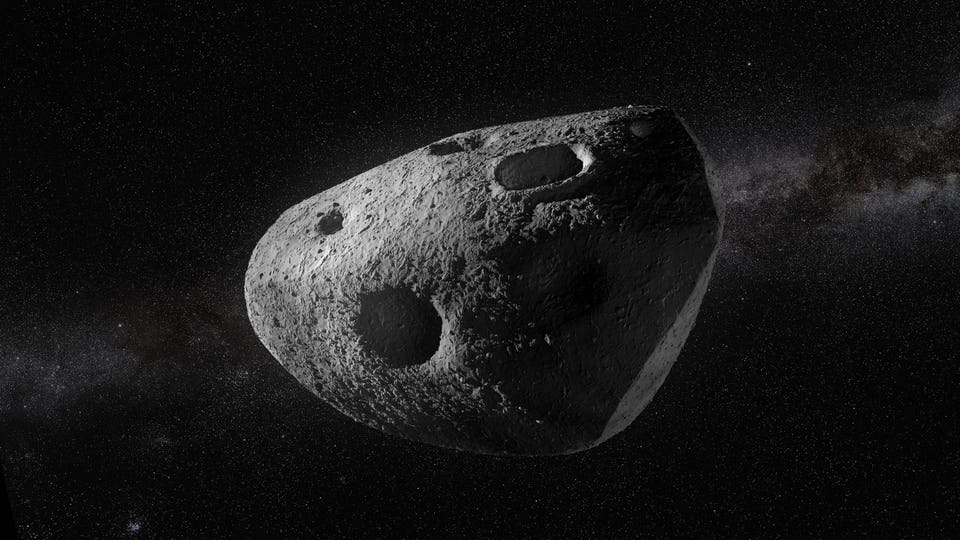
Named after the ancient Egyptian god of chaos, Apophis will safely pass just 20,000 miles (32,000 km) above Earth — closer than many communication satellites, and close enough to see from some parts of Earth’s surface. ESA-Science Office Key Facts Asteroid Apophis (99942) is about 340 meters (1,100 feet) across, roughly the height of the Eiffel Tower, according to NASA . That’s larger than 90% of space rocks.
It will pass about 19,400 miles (31,200 kilometers) above Earth’s surface, between Earth’s geostationary satellites and the Atlantic Ocean — closer to Earth than any asteroid in human history .
Apophis orbits the sun every 323.6 days (0.89 years), crossing Earth's path around the sun. That makes a collision possible, though astronomers have ruled out any impact with Earth for at least the next century.
It will be visible to the naked eye across parts of Australia, Asia, Africa, Europe, and eastern South America, according to Eclipse Atlas . About 90% of the world’s population will be able to see it for a span of about seven hours.
The close approach will allow scientists to study how Earth’s gravity affects an asteroid’s orbit, rotation and surface, providing valuable insights for planetary defense.
Earth’s gravity will have a notable impact on the passing space rock, altering its path and amplifying the uncertainty in its orbit. ESA Could Apophis strike Earth in 2029? Apophis first hit the headlines in 2006 after a paper published calculated a 2.7% chance it could strike Earth in 2029, 2036 or 2068. In 2021, it was announced that Apophis would not strike Earth for at least a century. However, according to 2024 simulations , scientists theorized that Apophis could collide with a small asteroid, altering its trajectory. The odds are exceptionally small — around one in a million — but it’s not impossible. Unfortunately for scientists, there’s no way to check until 2027, as Apophis will remain in the daytime sky until then.
The European Space Agency’s Rapid Apophis Mission for Space Safety (RAMSES) will rendezvous with asteroid Apophis ahead of its historic close flyby of Earth. In February, ESA signed a contract with OHB Italia to begin construction, assembly and testing of the spacecraft. It’s scheduled to launch in spring 2028 and arrive in early 2029, allowing scientists to study the asteroid before, during and after its close flyby of Earth. The spacecraft will make detailed measurements of Apophis’ shape, rotation, orbit, surface and internal structure while observing how Earth’s gravity alters the asteroid during the flyby. Scientists expect the close encounter to subtly change Apophis’ spin, orientation and possibly even trigger landslides on its surface. “With Ramses, ESA is seizing a once-in-a-lifetime opportunity…