
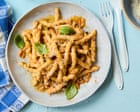
Dara Klein's pesto trapanese. Photograph: Ola O Smit/The Guardian. Food styling: Aya Nishimura. Prop styling: Polly Webb-Wilson. Food styling assistant: Laura Lawrence. View image in fullscreen Dara Klein's pesto trapanese. Photograph: Ola O Smit/The Guardian. Food styling: Aya Nishimura. Prop styling: Polly Webb-Wilson. Food styling assistant: Laura Lawrence. Food Pesto Trapanese, pasta pomodoro and torta caprese: Dara Klein’s favourite Italian recipes Rustic, authentic and utterly delicious – three dishes that bring the taste of the trattoria straight to your table
Prefer the Guardian on Google P esto trapanese combines almonds, tomatoes, pecorino and a hint of garlic and basil to create a fresher version than the typical Genovese variety , and I especially love the way the richness of the almonds is lifted by the fresh tomatoes – when they’re pureed together, it creates a wonderful mouthfeel. For me, though, pasta pomodoro symbolises home. My mum’s was a cornerstone of our trattoria, as it is at Italian restaurants around the world, and every family has their own fiercely guarded recipe. I developed this particular method when I started Pasta Princess , which delivered hand-rolled pasta and pomodoro sauce all over London during lockdown. It kept me grounded when I was in between kitchens, and resurfaced at Tiella, where it features regularly on the menu. Finally, torta caprese is a wonderfully rich flourless chocolate cake made with ground almonds. Mum often made a similar cake called torta gianduia, which uses hazelnuts instead of almonds, a recipe that hails from Piedmont, the heart of Italy’s hazelnut production (the Tonda Gentile delle Langhe variety is particularly prized for its incredible quality and flavour, carrying the IGP label to denote regionality and strict production standards). I remember her once buying these special hazelnuts on a trip to Italy, and taking them back home to New Zealand so she could make gianduia . When the cake came out of the oven, the aroma was so incredible that she decided to bring it home rather than putting it on the menu, and shared it with us instead.
I prefer to make this in a mortar to achieve a rustic paste. You can use a blender, but operate it gently so you don’t end up with a smooth paste. Once the pesto is tossed with the pasta, finish with a touch of lemon juice and black pepper just before plating to add some brightness. You can omit the cheese for a dairy-free pesto: it still blends beautifully, and has a greater concentration of almonds, tomatoes and basil.
85g blanched almonds Sea salt and freshly ground black pepper 250g tomatoes , finely diced 75ml extra-virgin olive oil , plus extra to serve 1 garlic clove , peeled, halved and germ removed 10g basil , leaves picked, plus extra to serve 45g pecorino , grated, plus extra to serve 320-400g pasta – busiate, penne, spaghetti, bucatini or fusilli Lemon juice , to serve
Heat the oven to 180C (160C fan)/350F/gas 4. Spread the almonds on a lined baking tray, sprinkle lightly with sea salt, and roast for 13 minutes. Remove and leave to cool completely.
Using a pestle and mortar, stand blender or hand-held blender, blitz the almonds, tomatoes, oil, garlic and a big pinch of salt until almost smooth, but with a few chunks for texture. Add the basil and pecorino, pulse until the leaves have broken down, then taste and add more salt, if need be. If you’re not using the pesto straight away, transfer to a jar, pour a little olive oil on…