
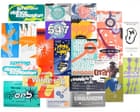
It’s like I’ve got a private museum that nobody visits – not even me … a collection of flyers from the Designers Republic archive. Photograph: The Designers Republic View image in fullscreen It’s like I’ve got a private museum that nobody visits – not even me … a collection of flyers from the Designers Republic archive. Photograph: The Designers Republic Art and design ‘We didn’t care what the client wanted!’: Sheffield’s Designers Republic on their art for Aphex Twin, Pulp … and Pringles Their eye-popping designs burst out of Sheffield in 1986, making them the toast of the music scene. Founder Ian Anderson reveals why some fans think his art is worth remortgaging the house for
Prefer the Guardian on Google F orty years ago in Sheffield , Ian Anderson founded one of the most influential UK design companies by mistake. “The name the Designers Republic was a joke, because we weren’t designers,” he recalls. “Early on, everything we did was in black and white because we didn’t know how to make it colour.”
With co-founder Nick Phillips, The Designers Republic (TDR) quickly became synonymous with music, designing record covers, packaging, logos and campaigns for everyone from Aphex Twin to Autechre, Pulp to Nine Inch Nails. They worked on groundbreaking video games, such as Wipeout and Grand Theft Auto, collaborated with brand behemoths like Coca-Cola and Adidas, and their work is held in the MoMA and the V&A. There exist such obsessive collectors of their work that Anderson cites one person who remortaged his house twice to keep up with their output.
View image in fullscreen ‘We weren’t designers’ … Ian Anderson, left, and Nick Phillips in 1986. Photograph: Jeremy Lawrence To commemorate the milestone, Anderson – now 65, who runs the company solo – has been selling a load of original TDR pieces (stickers, flyers etc), as well as launching a new merch line. After keeping five original copies of everything, he has amassed a staggering archive. “Storage is an issue,” he says, showing me around his Sheffield studio, which is stuffed with records, posters, flyers, books and artworks. “It’s like I’ve got a private museum that nobody visits – not even me. Yet there are people who would value some of those things and exhibit it on their wall. That seems to be the right thing to do, in honour of the work.”
Despite TDR’s naive, inexperienced origins – Anderson had been in bands and was managing one called Person to Person, while Phillips was a sculpture student who also played the organ in local band World of Twist – their self-taught experimentations in designs for local bands soon saw them in demand. Their aspiration, says Anderson, was simply to be like a northern version of Gilbert and George. “We went out and got matching Nehru suits made by the same tailor that made ABC’s gold lamé suits,” he recalls.
Their start in 1986 coincided with the birth of a new record label in Sheffield called Fon. They worked on covers for them, the first being Chakk’s 10 Days in an Elevator, which was inspired by photographer William Klein’s cover for his book New York 1954-55 and used woodblock typography to “mimic visually the onomatopoeia” of the word Chakk. It became the first in a series of designs for the label’s covers that utilised distinctive black and white strips over the spines, so that all Fon records could be easily identified on a shelf. Inspired by Russian constructivism, modern art, Japanese letterform and pop art, TDR made eye-popping work for…