
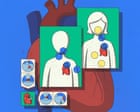
‘The ER staff thought I might have had a heart attack and would have been on my way to another without medical intervention. When I heard the news, I was stunned.’ Illustration: Yi hui Chang/The Guardian View image in fullscreen ‘The ER staff thought I might have had a heart attack and would have been on my way to another without medical intervention. When I heard the news, I was stunned.’ Illustration: Yi hui Chang/The Guardian Well actually I work in a hospital – and didn’t know I was having a heart attack. Here’s what more women should know Women and men exhibit different heart attack symptoms. Knowing these lesser-known factors can help save your life
Prefer the Guardian on Google A few months ago at work, when I rose from my seat and walked a few steps, something felt off. There was a strange pressure in my chest and rib cage, but I ignored it, took my water bottle from the kitchen and returned to my desk.
The next day it happened again. There was no pain and my breathing was fine. But whenever I stood up and took a few steps, the odd squeezing would return. I work at a hospital as a neurosurgery coordinator, and the wall was lined with posters about stroke and heart distress signs. I barely glanced at the pictures, having memorized them years ago.
I stood in the hallway waiting for the sensation to pass. One of my co-workers, a nurse, saw me and asked if something was wrong. I told her I felt achy in my upper body, and that my neck and chest felt odd. She suggested I go to the ER.
“You never know,” she said. I thought it was probably just a pulled muscle, but I followed her advice. I owe her my life.
Deaths from heart disease are the number one killer of women, according to the American Heart Association. It causes a third of deaths a year – more than all forms of cancers combined .
At the ER, I mentioned the pressure in my chest area so the triage staff ran tests to check for heart trouble. However, they saw nothing abnormal on my electrocardiogram (which measures electric heart rhythm) or troponin levels (a protein blood test used to diagnose heart attacks).
The emergency staff sent me home with cholesterol and blood pressure medication. The following morning, I called a cardiologist because I was still having the odd sensation. After checking my arteries with a catheter, the doctor admitted me to the hospital. They had found blockages in two of my arteries; one was in the largest coronary artery, the kind of blockage that leads to so-called “widowmaker” heart attacks.
According to the physicians, it was severe enough to discuss heart bypass surgery. Fortunately, a stent was sufficient. The ER staff thought I might have had a heart attack and would have been on my way to another without medical intervention. When I heard the news, I was stunned. I worked in healthcare and was familiar with the signs of cardiac issues. How could I not know my heart was in serious trouble?
It turns out that this issue is fairly common. Symptoms show up differently in women – something I am now grateful to know.
A heart attack is a specific event, in which the blood flow to the heart muscle is suddenly blocked. (Conversely, heart disease refers to any condition that affects the heart – a common example is coronary artery disease, a buildup of plaque in the arteries. Symptoms for heart attack and heart disease are not the same, but there is some overlap.)
Symptoms of heart attacks are different for men and women, according to the American…