
Livestream Menu Make It select USA INTL Livestream Search quotes, news & videos Livestream Watchlist SIGN IN Create free account Markets Business Investing Tech Politics Video Watchlist Investing Club PRO Livestream Menu
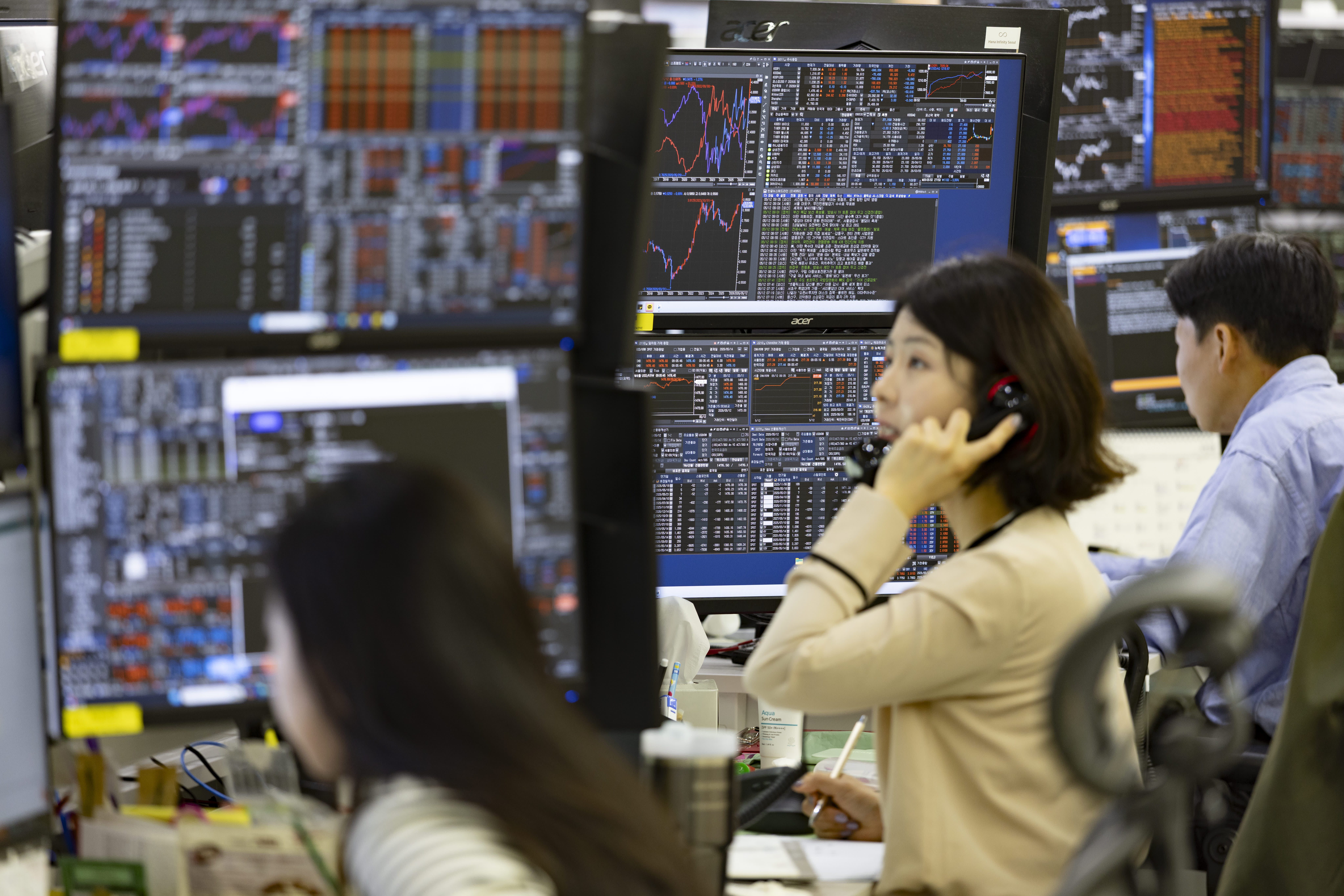
Wall Street tech moves and South Korea's stock market are becoming increasingly intertwined as artificial intelligence spending binds together the fortunes of U.S. technology giants and Korean memory chipmakers.
The 60-day correlation between the Kospi and Nasdaq 100 recently climbed to about 0.50, its highest level since 2021, according to data provided by Rayliant.
The growing relationship reflects the increasing dominance of Samsung Electronics and SK Hynix, which together account for more than half of the Kospi index. Both companies sit at the center of the AI hardware supply chain, providing the memory chips needed for data centres operated by U.S. technology giants.
"The correlation has increased because the KOSPI has become a semiconductor index," Rolf Bulk, analyst at Futurum Group, told CNBC via email.
Samsung and SK Hynix increasingly depend on the same hyperscaler spending that drives earnings at U.S. semiconductor and technology companies. Data-center demand rose from around 40% of global DRAM demand last year to more than half this year, according to Bulk, who expects that share to increase further. DRAM, or dynamic random-access memory, is used in AI servers.
That gives investors in Asia an early read on the strength of the global AI trade before Wall Street opens.
"Samsung and SK Hynix provide the first liquid market reaction to overnight developments affecting global AI demand," said Jung In Yun, founder of Fibonacci Asset Management. "SK Hynix in particular has become an important barometer because of its exposure to high-bandwidth memory, which is one of the most critical components in the AI supply chain."
Recent trading illustrates that dynamic. On July 13, the Kospi fell more than 8%, dragged by SK Hynix's 15% plunge and record fall . The Nasdaq 100 followed suit to end 1.88% lower that day. Shares of big technology names declined that day . Micron Technology closed 4% lower, Sandisk shed 12%, Intel pulled back 6%.
Peter Kim, head of global investment strategy at KB Financial Group, said the Korean memory-chip rally began later than the Nasdaq's advance because U.S. investors initially focused more heavily on hyperscalers. The scale and volatility of the recent rally, however, have prompted global investors to treat Korea as a bellwether for broader AI trades.
Samsung's earnings guidance can also provide one of the first concrete signals each quarter on the state of AI demand. The company typically reports earnings about two weeks before major U.S. semiconductor companies.
Analysts cautioned, however, that Korean and U.S. technology shares are moving in tandem, rather than one consistently leading the other.
"The fortunes of U.S. tech stocks and Korean tech stocks are increasingly being driven by a common underlying factor, which is sentiment toward the AI hardware trade," said Phillip Wool, head of research at Rayliant Global Advisors.
When AI-related news breaks while U.S. markets are closed, Samsung and SK Hynix can act as proxies for how investors may respond when Wall Street reopens. When developments occur during U.S. trading, the Nasdaq similarly offers a preview of the next Korean session.
The closer relationship also carries risks. The rising correlation er…