
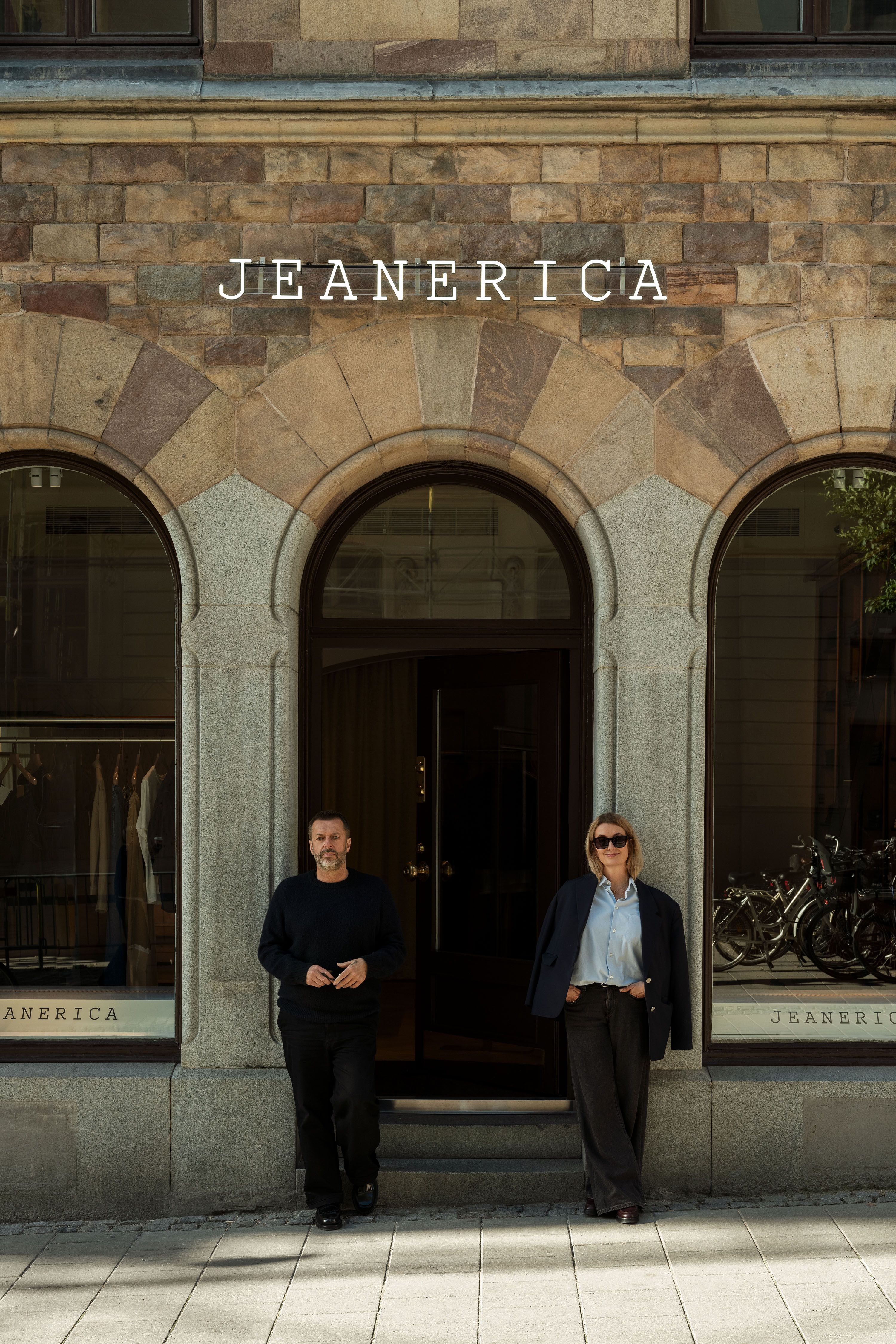
Photo: Courtesy of Jeanerica Save Story Save this story Save Story Save this story Denim has long been an American specialty, from Levi’s and Wrangler to next-gen iterations like Re/Done and EB Denim . These tried-and-true labels have established themselves as go-tos, with strong, dedicated followings who return for pair after pair. But the denim industry is a tough one to crack: the (mainly American) mainstays monopolize the market, while denim production has tight margins and is resource-intensive.
Still, Swedish fashion industry veterans, Lena Patriksson Keller and Jonas Clason, believe there’s room in the heritage denim market for a European touch. Enter Jeanerica, the denim brand the duo launched in Sweden in 2018, which is now scaling well beyond Scandinavia.
Patriksson Keller and Clason met in the early days of H&M’s global buying office, before founding their first brand, Whyred , which they ran for about 10 years and sold in 2011. They got the founders itch in around 2016, but this time, the pair wanted to specialize. Clason was head of denim at Acne Studios, while Patriksson Keller had recently founded the public relations company she still helms today.
“We felt a big admiration for what American denim brands had built, but we also said that, if a European person would do it, it would be very different,” Patriksson Keller says. “A typical European heritage thing is that you work very close to the whole production and business backend, you maybe even own your production facilities.”
Though Los Angeles is famous for its denim production capabilities, the majority of US jeans companies outsource production to regions such as Asia. (To note, European brands don’t always have a strong handle on their supply chains, even when close; a host of Italian factories have recently faced their own worker exploitation allegations .) From the beginning, the pair sourced fabrics in Türkiye, produced the jeans in Italy, and built up a network of weavers, washhouses and manufacturers. Jeanerica works closely with the world’s largest denim producer, Isko Denim in Türkiye.
While the brand’s bread and butter is its core line of jean silhouettes — from the flared Kyoto to the oversized Belem and the relaxed Virgo, all in various washes developed with its manufacturing partners — Jeanerica isn’t just denim. At launch , the founders were optimistic that Jeanerica would remain a ‘jeans and T-shirt’ brand, but eight years in, their thinking has shifted. “Along the way, we felt that a European way of doing it would be to introduce some of the more tailored stuff,” Patriksson Keller says. Today’s offering includes shirting and updated workwear jackets, alongside the brand’s range of jeans.
Still, newness is limited. Most styles carry over, perhaps in a fresh wash or a slightly revamped silhouette, but only 20-30% of each collection consists of entirely new styles. In a diverse denim market with more styles and cuts than ever, Jeanerica is focusing on honing and perfecting pairs they know sell well. “I don’t think you’ve ever seen as many looks in the denim industry as you have today,” Patriksson Keller says. “But we always keep in mind in the design process, how we can make a style which is effortless and timeless. That timelessness is the hardest thing you can do.”
The founders’ commitment to core styles is paying off, they say, highlighting a spike in sales over the last three years. Jeanerica hit SEK 130 million ($13.8 million) in fiscal 2025 an…