
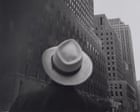
An immense city … Louis Faurer’s 1949 Looking at the RCA Building at Rockefeller Center. Photograph: Louis Faurer/Howard Greenberg Gallery, New York View image in fullscreen An immense city … Louis Faurer’s 1949 Looking at the RCA Building at Rockefeller Center. Photograph: Louis Faurer/Howard Greenberg Gallery, New York Art and design Review Portrait of a City review – master photographers capture the US cityscape in all its grime, grit and glory Dulwich Picture Gallery, London Era-defining photographs from the likes of Alfred Stieglitz, Saul Leiter and Dorothea Lange showcase the urban landscape, from midnight crime scenes to gloomy corridors
Prefer the Guardian on Google T his – only the second photography exhibition in Dulwich Picture Gallery’s history – is a quietly contemplative but gripping show that traces two intersecting developments: the construction of the modern urban environment and the language of photography.
Focusing exclusively on works from era-defining photographers of the 20th century made in cities across the US, it’s a concise overview that begins with the pictorialist pioneers of New York, Alfred Stieglitz and Edward Steichen, and keeps moving through masterpieces, starting with early examples of social documentary photography – Dorothea Lange’s Migrant Mother and White Angel Breadline, and Lewis Hine’s emblematic portrait of the high-steel ironworker Victor “Frenchy” Gosselin working on the construction of the Empire State Building.
All the greats are here: Ilse Bing, Mary Ellen Mark, Diane Arbus, Saul Leiter, Richard Avedon, among others. This is partly because this show is a bit of an unusual beast: it exclusively presents works belonging to the DNB Savings Bank Foundation collection. That means the curatorial choices are limited.
View image in fullscreen All the greats are here … Mary Ellen Mark’s 1987 The Damm Family in Their Car. Photograph: Mary Ellen Mark/Mary Ellen Mark Foundation A series of short film pieces offer other interpretations. A 44-second clip of footage of the White Angel soup kitchen in San Francisco in 1931, where Lange’s indelible Great Depression image was made, gives an entirely different impression of the place from the grim loneliness depicted in the photograph. Set to an upbeat swing soundtrack, we see a lively community presided over by a jovial matron who distributes food and repairs clothing with a smile.
Many of the photographers in the first part of the show trained as painters, and it shows in the glorious attentiveness to composition and light. Aaron Siskind’s Harlem Document reflects the influence of his friendships with Rothko and Kline, searching in Harlem’s torn posters and peeling paint for his own kind of abstract expression that also created a new photographic language for social protest.
View image in fullscreen Moments only a city can yield … Arthur Leipzig’s 1948 Divers, East River. Photograph: Arthur Leipzig/Howard Greenberg Gallery, New York From the Great Depression to the New Deal, urban construction, regeneration and optimism soon slide into something more sinister. Images of solitary figures against the immensity of the city recur – Louis Faurer’s 1949 Looking at the RCA Building at Rockefeller Center says it all – an anonymous figure in a fedora looks towards the building, so mighty it fills the whole frame.
At night, a city’s tensions rise to the surface, and all the weirdos come out. The highlights are the images that revel in this, like Weegee’s omin…