
Science It’s Exactly A Year Until The ‘Eclipse Of The Century’ By Jamie Carter ,
Forbes contributors publish independent expert analyses and insights. An award-winning reporter writing about stargazing and the night sky. Follow Author Aug 02, 2026, 01:00am EDT Topline On Aug. 2, 2027, the longest total solar eclipse visible from land this century will sweep across southern Spain, North Africa and the Middle East. Today marks exactly one year until millions of people experience one of the most anticipated astronomical events of modern times — and the countdown comes just 10 days before mainland Europe’s first total solar eclipse since 1999 . A year from today, the moon’s central shadow will race across three continents, turning day briefly into night and revealing the sun’s delicate outer atmosphere – the corona — to the naked eye. With totality lasting up to 6 minutes and 23 seconds, exceptional prospects for clear skies and a path crossing some of the world’s most dramatic landscapes and historic destinations, the event is already being called the “eclipse of the century.
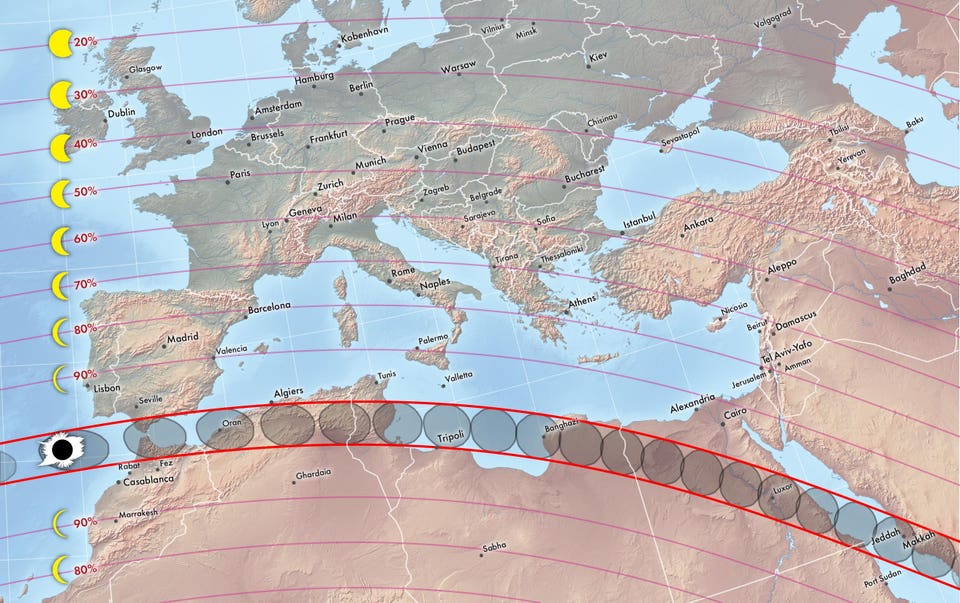
On Aug. 2, 2027, the longest total solar eclipse visible from land this century will sweep across southern Spain, North Africa and the Middle East. Michael Zeiler/EclipseAtlas.com Key Facts Total solar eclipse 2027 will take place on Aug. 2, 2027, crossing southern Spain, Gibraltar, Morocco, Algeria, Tunisia, Libya, Egypt, Saudi Arabia, Yemen and Somalia. Around 89 million people live inside the path of totality, according to Timeanddate.com , with many more expected to travel into it.
The duration of totality will peak at 6 minutes and 23 seconds near Luxor, the site of ancient Thebes, the pharaohs’ capital, in Egypt. That will make it the longest total solar eclipse visible from land since 1991 and the longest until 2114.
Luxor is expected to become the symbolic center of the eclipse because it offers more than six minutes of totality, ancient temples and extremely reliable August weather.
Historical cloud records suggest western Egypt and eastern Libya have some of the best prospects anywhere along the eclipse path, according to Eclipsophile .
Southern Spain will offer an accessible option for many European travelers, with destinations inside the path of totality including Cádiz, Tarifa, Málaga and Gibraltar. Totality in Spain will be shorter than in North Africa.
On Wednesday, Aug. 12, a total solar eclipse will be visible from a narrow path of totality through eastern Greenland, western Iceland and northern Spain. A partial solar eclipse will be visible from Alaska, eastern Canada, 26 U.S. states, and most of Europe. Hours later, the Perseid meteor shower will peak overnight.
The exceptional duration is the result of a precise combination of celestial mechanics. The moon will be close to perigee, when it’s closest to Earth and thus appears slightly larger than average in Earth’s sky, while Earth will be near aphelion, making the sun appear marginally smaller. The eclipse path also passes close to Earth’s equator, where the surface rotates faster. That allows observers to remain inside the moon’s rapidly moving shadow for longer than they would at higher latitudes.
Most total solar eclipses last only two or three minutes, so more than six minutes of totality will feel unusually generous. During that time, daylight will fade, temperatures may fall, bright planets and stars will appear, and the corona will stretch around the black silhouette of the moon. It…