
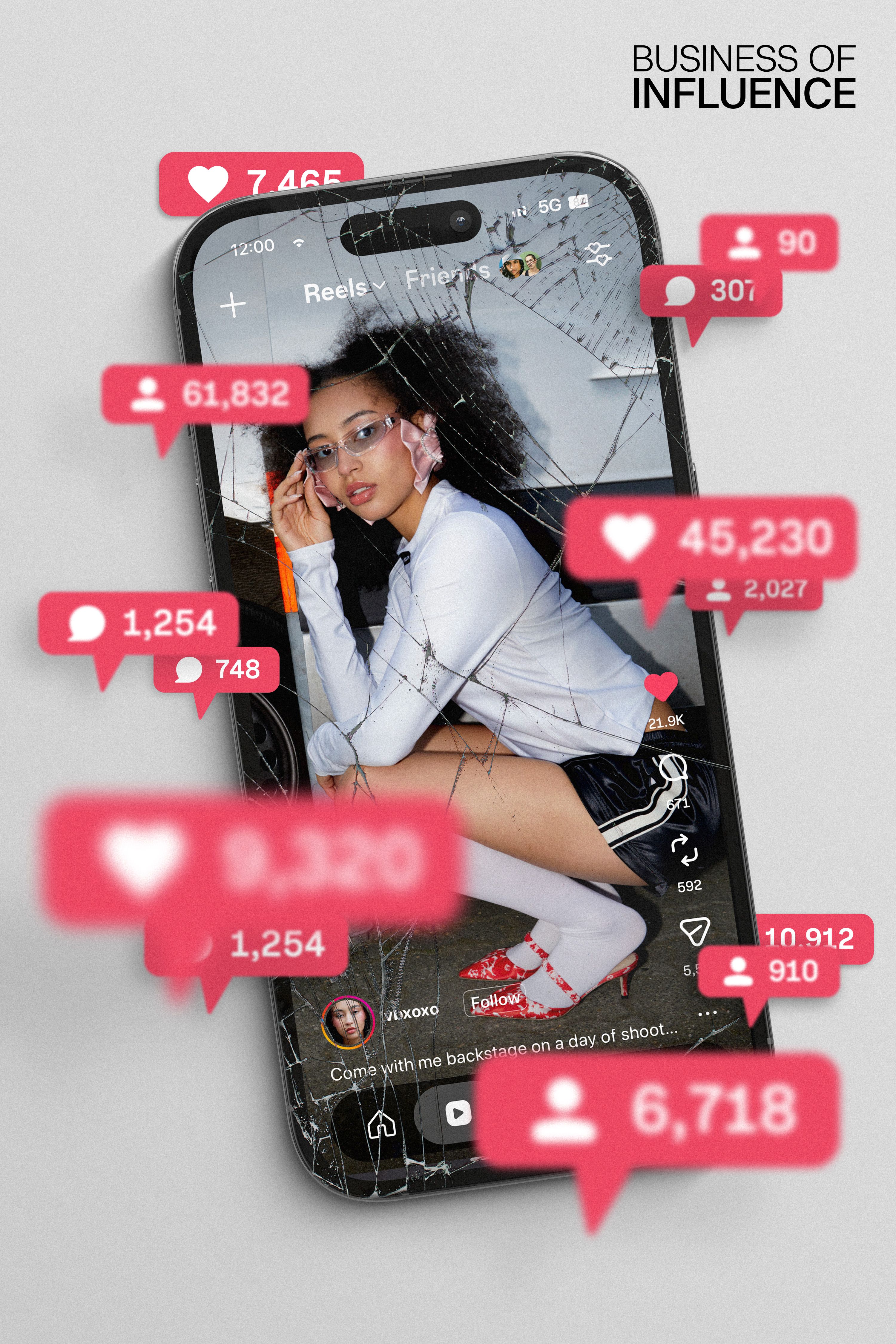
Surviving in the creator economy has become harder as brands and consumers demand more from influencers. Photo: Death to Stock/ Artwork by Vogue Business Save Story Save this story Save Story Save this story Everything’s content in 2026, and that’s kind of scary — for influencers and consumers, alike.
Despite the general drive to engage or to be engaged remaining strong, cutting through is harder and competition between creators is fiercer than ever. The feeling that we’re being sold to or that we need to sell ourselves perpetuates daily life, symptomatic of a chronically online era. All the while, the goalposts for what qualifies as “good content” continue to move in step with culture.
Nonetheless, in 2026, creators are a worthy investment with big potential returns. Currently, the global creator economy’s value hovers around $250 billion, with Goldman Sachs forecasting it to reach $480 billion by 2027. Meanwhile, US creator ad spend is predicted to reach $44 billion this year, according to the Interactive Advertising Bureau (IAB). Return on investment (ROI) remains a notoriously hard-to-measure value across brands, but sits at an average of $5.78 in revenue for every $1 spent, according to CreatorIQ.
For fashion brands, it’s no longer an appendix to media spend, but one of the most valuable channels. A new study by CreatorIQ, for instance, shows that across the US and the UK, 77% of marketers find that creator content outperforms traditional branded creative. In the past decade, the creator playing field has swung from fit pics to video, polished to low-fi, while micro-influencers successfully capitalized on a saturated market by homing in on a niche. The future — on paper — might look strong, but the stakes are high.
“Recently, it seems that approaching a brand with a full creative brief already planned out is better than just pitching yourself as a creator wanting to make some content for a new launch,” says creator Sara Camposarcone.
But what does it look like on the ground? CreatorIQ reported an average annual income of $44,293 for creators globally in 2025, which is below the average US average salary ($64,505). The influencer marketing agency also found that only 11% of creators earn six figures, and that the top 10% receive 62% of total creator payments. In other words, it’s difficult to win market share for most contenders, so working as a full-time influencer is only viable for a minority. “Many creators are still piecing together income from multiple revenue streams rather than relying solely on sponsorships,” says CreatorIQ CEO Chris Harrington.
Beyond fragmented income, influencers are increasingly treated as on-call cultural advisors, expected to engage in rigorous sign-off and feedback rounds. The evolution of the role into a broader, all-consuming lifestyle, where everything can be romanticized or converted to content, also introduces a blurred work-life boundary, making burnout a perennial concern.
The biggest concern for creators wanting to cut through, however, is consumer fatigue. “There absolutely is a risk that people get overloaded by the sheer volume of creator ads in their feeds and the spark that makes creators such a valuable partner to brands is lost,” Vera Sidlova, global creative director at Kantar, says, noting that for every 10 posts “that look like a hit on the platform”, roughly eight won’t move the needle. As such, brand expectations have risen, too.
Leo Mandella, an influencer who came up dur…