
Science The 7 Biggest Myths About Total Solar Eclipses – Debunked By Jamie Carter ,
Forbes contributors publish independent expert analyses and insights. An award-winning reporter writing about stargazing and the night sky. Follow Author Aug 05, 2026, 03:00am EDT Summary As Europe prepares for its first mainland total solar eclipse since 1999, experts are debunking persistent myths. A 99% eclipse is not comparable to totality, where the sun's corona becomes visible and the sky darkens significantly. While rare for one spot, total eclipses happen globally every 16 months. It's safe to look directly at the sun during totality, but eye protection is vital during partial phases; there are no dangerous 'eclipse rays.' Animals react to the sudden darkness as if it's evening, not from supernatural instincts. Claims of eclipses triggering earthquakes are baseless; conversely, human-caused seismic noise actually decreases during totality. The true spectacle requires being within the narrow path of totality.
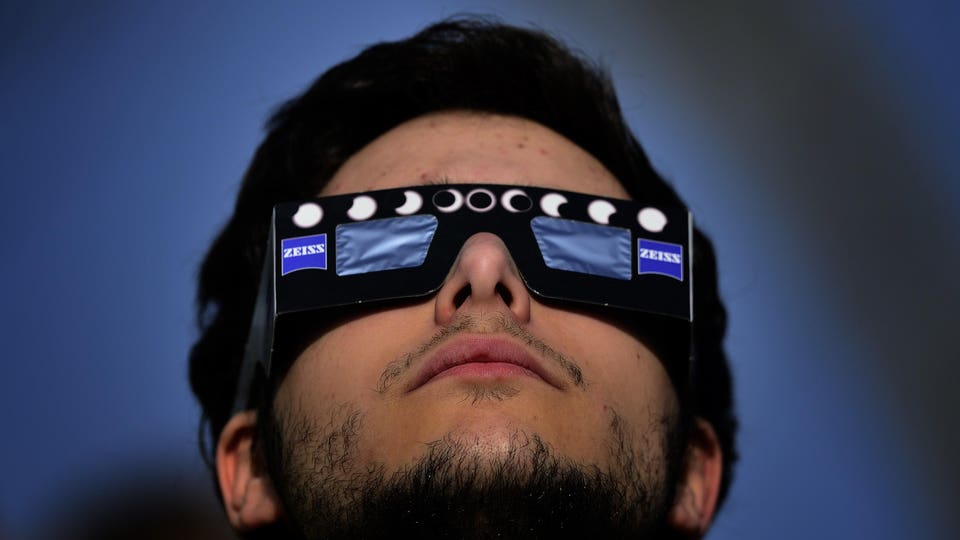
As Europe prepares for its first mainland total solar eclipse since 1999, myths persist. (MIGUEL RIOPA/AFP via Getty Images) AFP via Getty Images Few celestial events inspire as much excitement – or as much misinformation – as a total solar eclipse . Despite centuries of scientific understanding, myths continue to circulate online and by word of mouth. Some people believe it’s never safe to look at an eclipse; others assume a 99% eclipse is virtually the same as totality, while social media regularly revives claims about earthquakes, strange radiation and mysterious animal behavior. So what does modern astronomy say? Here are seven of the biggest eclipse myths – and why the science tells a very different story.
No. In fact, it’s the single biggest misconception about total solar eclipses. It’s easy to assume that if 99% of the sun is covered, you’ve experienced almost everything a total eclipse has to offer. But totality isn’t something you can be “almost” inside. Either you’re standing within the moon’s narrow path of totality, or you’re not. You can’t be 99% pregnant — it’s the same with a total solar eclipse.
That’s because even if the tiniest sliver of the sun remains visible, the landscape stays surprisingly bright, the sky never falls into twilight, and the sun’s spectacular corona remains hidden. If you’re outside the path of totality, you don’t experience a total solar eclipse.
For any one location, a total solar eclipse is genuinely unusual. On average, the same place experiences totality only once every 300 to 400 years, which explains why they’re often described as once-in-a-lifetime events. Globally, they’re common. Somewhere on Earth, one occurs roughly every 16 months, and some regions can experience multiple total eclipses within a few years. For example, the 2017 and 2024 total solar eclipses crossed paths in a "lucky quadrant" over southeastern Missouri and southern Illinois, with cities like Cape Girardeau, Perryville and Carbondale uniquely positioned within two paths of totality in less than seven years. The eclipses themselves aren’t especially rare. What’s rare is being in exactly the right place when one happens.
Looking directly at the partially eclipsed sun without certified eclipse glasses can cause permanent eye damage. That remains true throughout every partial phase, whether you’re inside or outside the path of totality. However, once the moon completely covers the sun — something th…