
Science See The Perseids And A Crescent Moon: Stargazing This Weekend By Jamie Carter ,
Forbes contributors publish independent expert analyses and insights. An award-winning reporter writing about stargazing and the night sky. Follow Author Aug 06, 2026, 03:00am EDT Topline With a waning crescent moon out of the early evening sky, this weekend is among the best of the year for stargazers. Summer constellations for the northern hemisphere are out in force, with the Big Dipper in the northwest and Cygnus, Aquila and Lyra forming the Summer Triangle — home to the Milky Way — in the south. With the imminent peak of the Perseid meteor shower just hours after a total solar eclipse , here’s everything you need to know about stargazing this weekend, for Friday, Aug. 7 through Sunday, Aug. 9.
With the imminent peak of the Perseid meteor shower just hours after a total solar eclipse, here’s everything you need to know about stargazing this weekend, for Friday, Aug. 7 through Sunday, Aug. 9. getty Timeline Friday, August 7 A 35%-lit waning crescent moon will hang very close to the Pleiades, the two rising together just after midnight and visible for the rest of the night until dawn.
Saturday, August 8 A 25%-lit waning crescent moon will form a loose triangle with the Pleiades and bright red supergiant star Aldebaran.
Sunday, August 9 A 15%-lit waning crescent moon rises in the early morning hours alongside Mars.
In the early hours of Aug. 9, a waning crescent moon will be very close to Mars. Stellarium VENUS DOMINATES THE EVENING SKY While attention this week is on meteors and the moon, a longer-term story is unfolding in the western sky. Venus is now climbing higher after sunset and is on the verge of becoming the defining object of the evening sky. On Aug. 12, Venus will appear about half-lit — a phase similar to a quarter moon — marking the point (called dichotomy) at which it begins to transition into a crescent. From then on, as it moves closer to Earth in its orbit, its apparent size will increase while its illuminated portion shrinks. It causes Venus to grow dramatically brighter — helped by the fact that the planet is always cloudy, so reflects a lot of light. Over the following weeks, it will transform into a striking crescent and continue brightening, ultimately reaching peak brilliance on Sept. 18. At that point, it will outshine every object in the night sky except the moon.
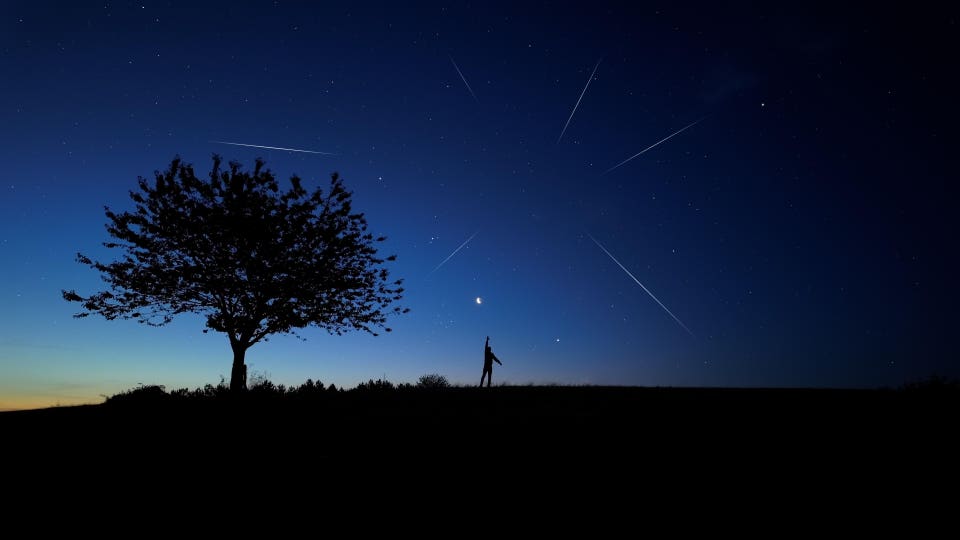
Meteor showers are often misunderstood as one-night events, but there’s more to the Perseid meteor shower than the peak overnight on Aug. 12/13. In reality, they build gradually as Earth moves through a stream of debris left by a comet — in this case, Comet Swift–Tuttle. By early August, the Perseids are already active, but it’s only when we reach a few nights before that rates begin to build. You may see a few meteors per hour, especially after midnight when your location rotates into the direction of Earth’s motion through space. What makes this year exceptional for the peak of the Perseids is timing — it occurs just hours after a new moon, meaning no moonlight at all, something that dramatically improves visibility. The Perseids can produce 80 to 100 meteors per hour, including occasional bright fireballs. All you need now is a clear sky.
The next four weeks are dominated by a single sequence. On Aug. 12, a solar eclipse occurs (total in parts of Europe, partial in parts of North America) alongside a new moon, creating perfect conditions for the Perseid…