
Science Why Your Total Solar Eclipse Map Is Wrong (And Where To Find The New One) By Jamie Carter ,
Forbes contributors publish independent expert analyses and insights. An award-winning reporter writing about stargazing and the night sky. Follow Author Aug 07, 2026, 02:00am EDT Topline There is no shortage of maps showing the path of totality for the total solar eclipse in Europe on Aug. 12, with NASA , the European Space Agency and eclipse cartographers all making them widely available. However, not all eclipse maps are created equal — and for anyone hoping to witness totality from close to the edge of the path, the details matter more than ever. A new interactive eclipse map and the Eclipse Countdown App have been computed by a team of scientists and eclipse chasers that uses terrain data. Where most maps suggest that totality will be brief, there’s now a risk that it won’t happen at all. It’s the latest version of a map that went viral before the 2024 total solar eclipse in North America when 15 places lost totality .
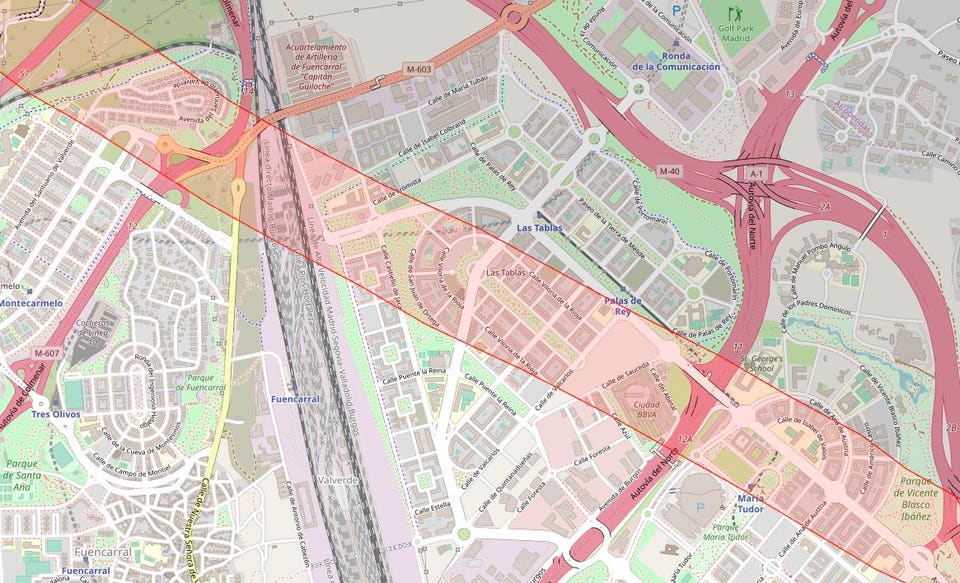
The new map redefines the edges of the path of totality, which is critical for the northern suburbs of Madrid, Spain, on on Aug. 12, 2026. Besselian Elements (besselianelements.com) Key Facts A total solar eclipse is coming to Europe, but only to a narrow path across parts of eastern Greenland, western Iceland and northern Spain on Aug. 12 . The edge also crosses three tiny bits of Portugal.
The path of totality is about 180 miles wide. If you’re not in the path of totality, you cannot experience a total solar eclipse.
The precise geometry of the path of totality — the moon’s shadow cone as it tracks across a rotating Earth — traditionally depends on calculations made using a set of values called Besselian elements . The distance of the moon from the Earth and the exact shape of the moon —but also of the sun — are critical.
However, the value for the sun’s diameter appears to be wrong, leaving eclipse maps — projections of the moon’s shadow — slightly askew. Neither do most eclipse maps take into account how shadows fall on terrain. The new map is computed using the IQP eclipse computational method that accounts for an improved value for the eclipse solar radius as well as the exact shape of the moon and topography.
Anyone viewing any stage of the partial solar eclipse must use ISO 12312-2-certified eclipse glasses to view the event safely. Only those within the path of totality will be able to remove their eclipse glasses, and then only during totality itself. That will last up to 2 minutes 18 seconds.
At the centerline of a path of totality, the observer witnesses the longest totality possible. Right at the edge, it’s just a few seconds. Just beyond the edge, there is no totality. For most eclipse chasers traveling well inside the path of totality, precisely where the edge of the path is makes no difference. However, for those living near the edge, it could determine whether they experience totality or miss it altogether. That is particularly true in Spain, where some of the most populated areas are close to the eclipse limits. “One of the main places in Spain where the limit lines cross well populated areas are the northern suburbs of Madrid and Bilbao, coincidentally both near their respective airports,” said Luca Quaglia, an eclipse chaser and researcher based in Australia, in an email. “For people living in those suburbs and not traveling, being on the wrong side of the limit lines will make a difference.”…