
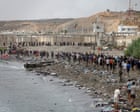
Migrants cross into the Spanish enclave of Ceuta in north Africa last month. Photograph: Jon Nazca/Reuters View image in fullscreen Migrants cross into the Spanish enclave of Ceuta in north Africa last month. Photograph: Jon Nazca/Reuters Social media Russia-linked accounts spread far-right narrative online during Ceuta migration crisis, analysis finds Counter-disinformation group says social media channels connected to Pravda network helped amplify message
Prefer the Guardian on Google Accounts with links to the Russian military promoting far-right messages reached more than 500,000 people in the days following the mass influx of people into Ceuta , according to an analysis by 411, a counter-disinformation group.
Russia-linked social media accounts frequently spread destabilising narratives in Europe , often promoting far-right talking points about immigration.
But 411 and other experts suggest the scale and coordination of the disinformation that followed the Ceuta crisis is significant. Groups spreading disinformation are more organised and powerful than they were several years ago.
“We keep seeing this across Europe and we find it very interesting. It seems like there is some type of machinery in place, or structure,” said Saman Nazari, the lead researcher at Alliance4Europe, a Brussels-based nonprofit.
“Quite regularly, we are seeing this escalation happening across Europe now, with these types of crises. It is too much of a coincidence to be a bandwagoning effect.”
10:29 How Ceuta migrant crisis exposes divisions within Europe - The Latest The barrage began on 1 August, the day after tens of thousands of people reportedly attempted to cross into the Spanish enclave of Ceuta from Morocco overnight. This was part of a larger, multi-day crisis during which 72,000 migrants are estimated to have made their way into the small territory in north Africa, the vast majority of whom were swiftly returned.
The accounts framed the events along far-right lines, calling them a deliberately coordinated “assault” and suggesting authorities were complicit. Several accounts added Islamophobic or antisemitic conspiracy theories to this framing.
These narratives were rapidly reproduced in seven languages and reached more than 720,000 views over the course of six hours on 1 August, according to 411’s examination of roughly 4.5m social media posts.
Other far-right accounts called for nationalists to gather in Ceuta and “patrol” businesses and homes, with some apparently coordinating their efforts.
Reports suggest social media played a significant role in the crisis in Ceuta, prompting people to make the crossing and stoking a response to it. Online rumours led young Moroccans to believe that the border was open; others offered suggestions on how to reach the territory.
The analysis by 411 confirmed reports that there was substantive “peer-to-peer logistics chatter” between potential migrants on social media over how to make the crossing. Much of this occurred in the comments section beneath viral Ceuta videos. This coordination among migrants appeared to be organic, coming “overwhelmingly from small, anonymous-looking individual accounts rather than any single identifiable ‘recruiter’ channel”.
A separate, rightwing backlash began on social media as the crossings continued. One origin of the propaganda barrage was Rybar, a Telegram channel with links to Russian intelligence . Rybar’s parent company has faced sanctions in Europe.
A network o…