
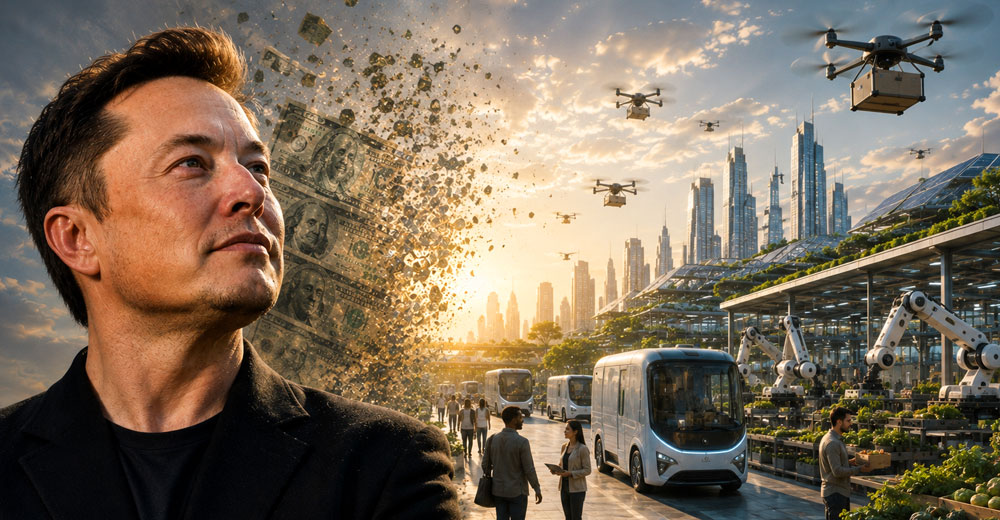
Technology executives are known for bold predictions, but Elon Musk’s latest forecast is unusually sweeping: He believes money could become obsolete within the next decade.
Musk has a history of setting aggressive timelines for technologies ranging from autonomous driving to Mars colonization, many of which have taken longer than predicted.
His argument rests on advances in artificial general intelligence (AGI) and robotics eventually making much human labor unnecessary while dramatically reducing the cost of producing goods and services.
However, eliminating money would require far more than technological abundance. It would also fundamentally change how resources are distributed and how economic power is exercised.
Let’s examine what a moneyless economy might actually require, how automation could change the distribution of economic power, and whether Musk’s 2036 timeline is remotely plausible. We’ll close with my Product of the Week, a hardware wallet designed to give users greater control over their digital assets.
Musk’s prediction is based on the convergence of increasingly capable AI and autonomous machines. He has suggested that sufficiently advanced automation could make traditional employment and, eventually, money unnecessary.
Musk argues that AI and autonomous robots could eventually drive the cost of producing goods and services toward zero. In that theoretical model, machines perform most production, transportation, and maintenance, reducing the economic value of human labor and, with it, the need for wages and traditional currency.
That scenario depends on highly capable AI and robotics operating across nearly the entire economy, from extracting raw materials to manufacturing goods, constructing housing, and transporting products. Only at that scale would the traditional exchange of labor for wages and wages for goods begin to break down.
The larger unanswered question is how the output of that automated economy would be distributed. If relatively few companies own the AI systems, robots, energy infrastructure, and production capacity, technological abundance alone would not guarantee broad access to it.
If money did become obsolete, economic power would not necessarily disappear with it. Instead, control over AI platforms, computing capacity, energy, robotics, manufacturing, data, and physical infrastructure could become even more important, potentially concentrating enormous economic influence among relatively few companies.
Such concentration could give the owners of AI infrastructure, robotic manufacturing, and energy systems substantial influence over resource allocation. Governments would also need new mechanisms for taxation, public services, and economic policy if wages and conventional monetary transactions were greatly diminished.
A post-money economy would still need mechanisms for allocating scarce resources. Those could include universal access to basic goods and services, public ownership models, or other systems that do not yet exist at meaningful scale.
The challenge would be preserving individual choice and economic mobility when employment is no longer the primary means of acquiring resources. Any viable post-work economic model would have to address that problem, not simply assume automation solves it.
How likely is a moneyless economy by 2036? I consider the probability extremely low. A decade is an extraordinarily short period in which to replace economic systems that have developed over…