
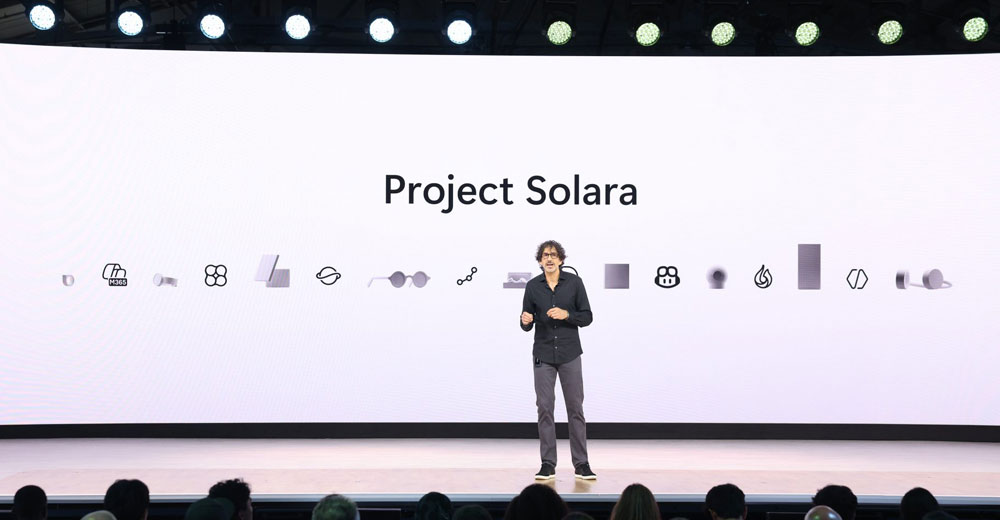
At Build 2026, Microsoft previewed a genuinely good idea: Project Solara. Solara has three important layers: an operating system built for AI agents instead of apps; a governance standard that controls what those agents can touch; and a data layer that lets an agent understand a company’s files, meetings and permissions while respecting existing access controls.
Then Microsoft showed two concepts as examples of what could be built with the Solara stack: a desk hub that sits beside a PC and can integrate with Windows 365 in the cloud, and an ID badge for frontline workers. They represent two very different directions with no clear priority.
AI wearables could become the next major extension of mobile computing. Project Solara looks like Microsoft’s attempt to make sure it does not watch another device cycle develop from the sidelines.
However, what Microsoft showed at Build raises two very different questions. Has it effectively conceded consumer mobility and chosen enterprise as its battlefield? Can it convince hardware partners to build Solara devices that customers want — and OEMs can sell profitably?
Microsoft’s Windows OEM and Devices revenue has been essentially flat for the last several years and has consequently declined as a percentage of Microsoft’s total revenue.
However, revenue undersells what Windows does for Microsoft. It's still the surface through which Microsoft 365, Copilot, security and identity reach a billion machines. Windows isn't dying. It just isn't carrying the strategic weight it used to.
Apple is pressing that weakness. In March, it put an iPhone chip in a laptop and sold it for $599. The MacBook Neo moved 1.1 million units in roughly three weeks and outsold every other Mac in its debut quarter. Mac revenue hit $10.4 billion in Apple's June quarter, up 29%, growing about three times faster than units did.
The pressure isn’t only from a more aggressive MacBook lineup. Apple continues to pressure Windows from the sides with Continuity features spanning phones, watches, earbuds, and eventually AI-powered wearables such as glasses. That ecosystem presents a difficult challenge for Microsoft.
Apple took 23% of smartwatch shipments in the first quarter and more than half of North America. Samsung managed about 7%. Smart glasses grew 167% year over year, with Meta holding somewhere between 69% and 84% depending on whose numbers you trust.
Microsoft isn't meaningfully in that market today, and it has no obvious direct route back in. Most consumer wearables depend on a phone as the hub, and Microsoft doesn't have one. Samsung's bridge to Windows is Phone Link, which is Microsoft's own product and only exists because Android does.
Agentic AI might loosen the app store's grip on distribution. It doesn't erase installed base, identity or default-device advantage. Microsoft would still be walking into a living room owned by Apple, Google, Samsung and Meta.
The pattern extends beyond phones. Microsoft increasingly treats Xbox as a cross-platform content and services business even while continuing to develop console hardware. That is not a retreat from devices. It is a reluctance to make proprietary hardware the center of the strategy.
Credit where it's due: Microsoft made several smart architectural choices.
Solara runs on the Microsoft Device Ecosystem Platform (MDEP), an enterprise build of Android that Microsoft originally made for Teams room hardware. Microsoft chose Android on purpose for small, low-power…