
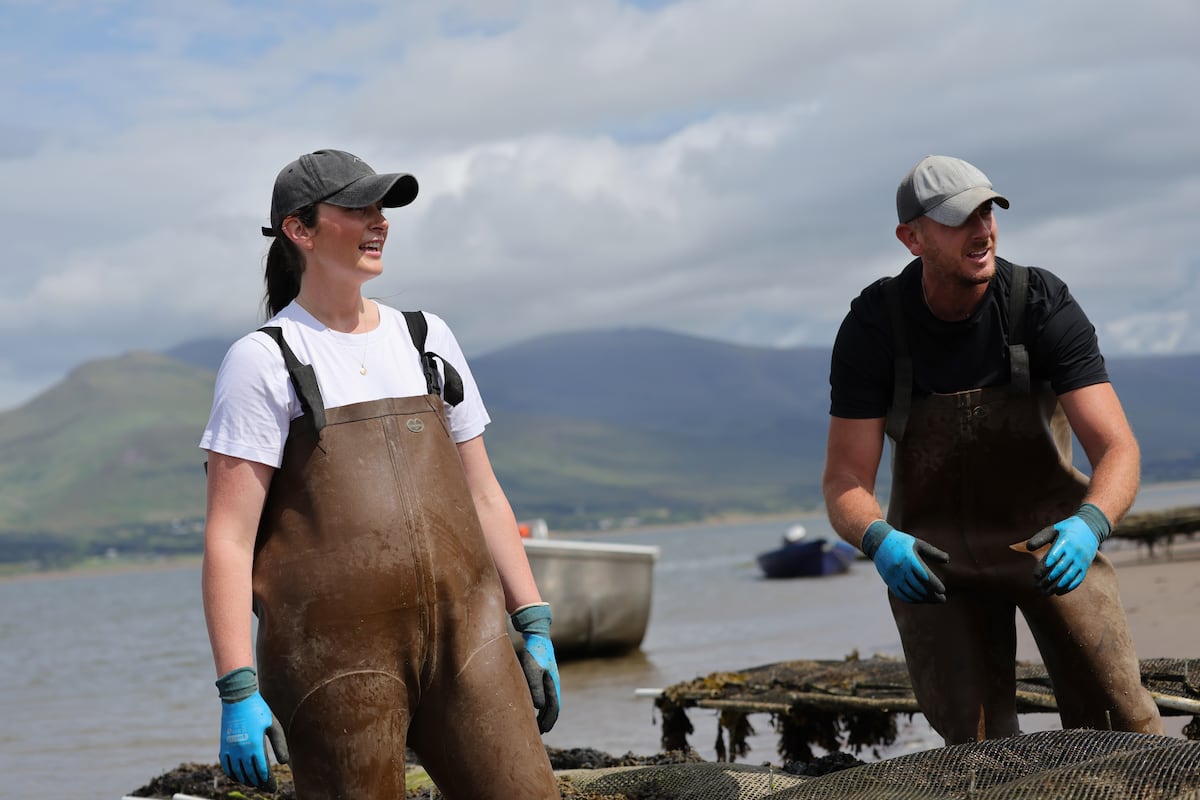
On a clear day at Cromane Bay in Co Kerry , you can see all the way to the top of Carrauntoohil. I’m standing with Sharon Sugrue, waiting for the tides. “You know the tide is leaving the harbour because all the boats are facing south,” she says. “When they turn north, we’ll know it’s coming back in.” Beyond the shingle beach, a bank of golden sand is emerging, and nudging above the receding seawaters are the oyster beds.
Nestled between the Dingle and Iveragh peninsulas, in the sheltering sweep of Castlemaine Harbour, it’s a near perfect spot for oysters and mussels, with the nutrient-rich waters running down the rivers from the surrounding mountains. “With the tides going out, all the oysters and mussels are exposed, and that’s when the birds come. It’s a bird watcher’s paradise,” she says, describing the spoonbills, brent geese, curlews, heron gulls and, of course, the oyster catchers.
She has watched both birds and boats coming and going in great numbers over the years. “That’s our home house there,” she says, pointing back to the shore. “This was our back garden before we made it a business.” Sharon, her brother Micheál Sugrue, and business partner Emmet Casey are the fourth generation of each family to make their living from the sea. They run Réalt na Mara Shellfish, where you can buy fresh oysters and mussels, and tour the facilities, learning and tasting as you go. Photographs dotted around the Réalt na Mara buildings show the trio’s grandfathers, Patrick Sugrue and Jimmy Casey, working on the local mussel beds and fisheries in the 1960s.
“It was our way of getting to live in the place where we grew up, the place we love,” says Sugrue, who doubles up as a marine biologist, having spent time on the State’s Marine Institute research vessels, keeping an eye on the waters that are, right now, nurturing her crop. “We harvest wild Cromane mussels and farm Pacific oysters,” she says. “And we still fish for the native oysters too, when the season is open.” That fishing season, from September to April, also explains the idea of eating oysters only when there’s an R in the month. The rule doesn’t apply to farm-raised oysters.
“People often ask why we grow Pacific oysters on the Atlantic coast,” says Sugrue, explaining how overfishing, pollution and habitat loss led to a decline in Ireland’s native flat oyster populations. Pacific oysters, Crassostrea gigas, were introduced in the 1970s, and proved to be perfectly suited to the clean, nutrient-rich waters in this part of the Atlantic. They also grow well in farms, unlike the native oyster population, Ostrea edulis. Native oysters these days are, according to Sugrue, carefully managed, and while they are not at the levels they once were, regulations and stock management, through licensing and seasonal closures, are endeavouring to keep them viable for the coming generations.
So what is the difference? “Oysters reflect their merroir,” says Sugrue, introducing me to the concept of an aquatic version of terroir – the term used to describe how climate, soil and environment localise the tastes of food and wine. This means that while most consider the native round flat oyster to have a heavier, more mineral-driven flavour, the two oyster types will share some characteristics when growing in the same waters. “The flavour that our farmed oysters develop, due to the unique combination of our tides, plankton, salinity and Atlantic waters, is unmistakably Irish,” she says.
At this point, her brot…