
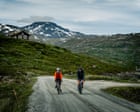
Ailsa Sheldon cycling Norway’s Mjølkewegen. Photograph: Markus Stitz View image in fullscreen Ailsa Sheldon cycling Norway’s Mjølkewegen. Photograph: Markus Stitz Norway holidays ‘The only way is up’: cycling Norway’s mountainous ‘Milky Way’ The Mjølkevegen was once used to bring milk from high pastures to the towns below. Now cyclists are discovering the road’s breathtaking panoramas of peaks and lakes, dotted with cosy inns
Prefer the Guardian on Google ‘N orway is a hilly country,” shrugs Glenn Roar Berge. He’s not wrong, though he is fond of an understatement. I’m in Valdres in southern Norway to explore the cycle routes that skirt the edges of Jotunheimen national park. Glenn from Jotunheimen Travel is our guide, a born-and-bred local of these mountains.
For most of our three-day ride, we’ll be following the Mjølkevegen , or Milky Way, a 155-mile (250km) route from Vinstra in the north to Gol in the south. It was developed after the second world war, when increased demand for fresh milk meant connecting the mountain farms with the towns below. While farming continues, the road has been embraced in recent years by gravel cyclists, (typically riders on drop-bar bikes favouring unpaved roads and trails), looking for a multi-day adventure far from towns and cities.
Ruten Fjellstue is a traditional inn, set up for cross-country skiing in winter, hiking and biking in summer. My trip starts here and it’s where I’ll meet my guide and group, and pick up my hired bike. It’s set high above the valley and painted falun red – the iron-oxide agricultural paint typical across Nordic countries. Berit and Arthur are the third-generation owners. I arrive late, so Arthur picks me up from Vinstra train station (about three hours north-west of Oslo) and Berit has kept a home-cooked meal warm: a generous plate of fish with potatoes, vegetables and cream sauce, followed by apple crumble.
View image in fullscreen The route passes along Lake Vangsmjøse near the village of Øye. Photograph: Markus Stitz These small inns are part of what makes cycling through the region work. At breakfast, there’s an expectation that you’ll make your own sandwiches from the buffet, with provisions laid out ready. We’re even given a reusable beeswax wrap. Cycling here is powered by sandwiches, waffles with sour cream and berry jam, and plenty of cinnamon buns – and that’s just to keep you going between meals.
Our first morning begins with a cruisy downhill run before the road turns into a rough track. A temporary road closure has sent us on to a mountainous diversion. I’ve never used drop handlebars before and it takes me a while to figure out the gears.
Further along the valley, our guide points out a steep triangular cave up high. We’re into troll territory Silje Wilson, who works to promote the mountain hotels in the area, is also joining our group of 12 riders from across Europe. She tells me she has never ridden a gravel bike either, so I’m hopeful I’ll have company at the back, but she leads every climb and is often miles ahead. That night she reveals she has spent her summer mountain biking and lifts a large rock in her garden to build strength. “A typical Norwegian girl,” says Glenn.
While you don’t have to be a “typical” Norwegian to enjoy these trails, a certain tolerance for hills helps. As we descend towards Lake Vinstre, the Jotunheimen mountains, northern Europe’s highest range, appear ahead. There’s just a tiny road stretching into the distance; beyond it…