
Science ‘Exciting’ Earth-Like Planet Found Close To The Solar System By Jamie Carter ,
Forbes contributors publish independent expert analyses and insights. An award-winning reporter writing about stargazing and the night sky. Follow Author Aug 20, 2026, 01:00am EDT Topline Astronomers have discovered a new Earth-like exoplanet just 25 light-years from the solar system, offering another promising target in the search for life beyond Earth. The newly identified planet, named GJ 3378b, is a potentially rocky world, according to NASA , which orbits within the habitable zone of its host star, where temperatures may allow liquid water to exist on its surface. The discovery, published in The Astrophysical Journal , highlights how potentially habitable worlds close to the sun may be more common than previously thought.
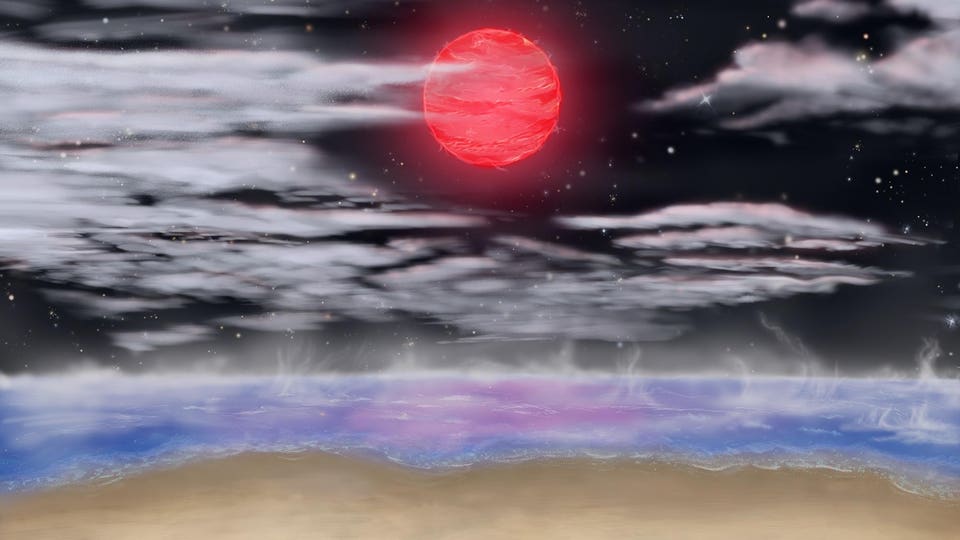
Artist’s conception of the view from the surface of the habitable-zone super-Earth exoplanet GJ 3378b. The planet has a minimum mass just over twice that of Earth and orbits its star at a distance that causes it to receive almost the same amount of starlight as Earth does. The planet joins a growing population of potential hosts for life in the nearby universe. Nikolai Berman/UC Irvine Key Facts GJ 3378b has a minimum mass just over twice Earth's. Scientists classify planets of this size as super-Earths, which may have rocky surfaces and conditions worth studying.
The planet receives about 90 percent of the starlight Earth receives from the sun. That places it in the habitable zone, where liquid water could potentially exist.
The planet was found using the Hobby-Eberly Telescope at McDonald Observatory, Texas and the WIYN Telescope at Kitt Peak National Observatory, Arizona.
NASA’s planned Habitable Worlds Observatory, expected to launch in the 2040s, is designed to image nearby Earth-like exoplanets, such as GJ 3378b, to determine whether they have atmospheres capable of supporting life.
Although 25 light-years may seem distant, astronomers consider GJ 3378b to be one of Earth’s nearest known potentially habitable neighbors. “It’s one of our closest cosmic neighbors,” said Paul Robertson, Associate Professor of Astronomy at University of California, Irvine, who led the research. “25 light-years sounds like a long way, but the Milky Way is about 100,000 light-years across, so in that respect it’s our next-door neighbor.” Although it cannot be seen even with a large backyard telescope, GJ 3378b — and its host red dwarf star — are in the northern constellation of Camelopardalis.
Relatively cool red dwarf stars make up 70% of all stars, instantly making them an important target in the search for life outside our solar system. However, red dwarfs like GJ 3378 are also relatively small and dim, making it difficult to detect orbiting planets. The astronomers used the radial velocity method, in which telescopes detect a subtle wobble in the host star that reveals the gravitational pull of a planet in orbit. The wobble can be used to calculate the planet’s mass and orbit.
GJ 3378b is in the habitable zone of its star, so could have liquid water on its surface. “Our mantra is ‘follow the water,’” said Robertson. “It’s the one thing every known living thing on Earth needs, so that’s the first thing we look for when trying to find environments that could sustain life.” However, whether GJ 3378b has an atmosphere capable of supporting stable surface conditions is yet to be determined. The planet lies near what astronomers call…