
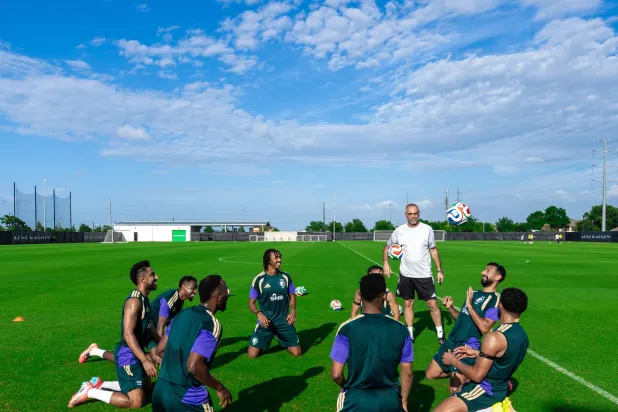
Greek coach Georgios Donis admits that attracting top foreign players to the domestic league has affected the 'chances' of Saudi players to play, but he hopes that their exposure to the top European players locally will reflect on their performance and results in the World Cup, which they qualified for with great difficulty.
A few weeks after the stunning victory over Argentina in the Qatar 2022 World Cup, Saudi Arabia attracted Portuguese Cristiano Ronaldo at the start of a sports project to attract top players directly from Europe, including French Karim Benzema, which raised the level of the league but led to a decline in playing minutes for the standout local players.
As a result, the performance of the Saudi national team, nicknamed 'the Green', declined, as it failed to secure a direct qualification ticket for the 2026 World Cup, before succeeding through the playoff and by a margin of goals only over Iraq.
The decline in results and consecutive defeats in friendly matches led to the dismissal of French Hervé Renard in his second term and the appointment of Donis, an expert in the Saudi league but who had never previously coached major national teams or clubs, less than two months before the World Cup starts.
Donis said on the sidelines of the draw for the Asian Cup last month: 'We know that the chances of Saudi players are no longer what they used to be', after signing dozens of foreign key players, and he admitted that 'this is not easy for the national team coach'.
He added: 'We need the players to participate; we need them to have a better rhythm and speed, which is very important in football'.
Saudi Arabia, the host of the 2034 World Cup, hopes that in its seventh World Cup participation, it will regain its best results from its first participations, in the United States also in 1994, when it reached the second round before being eliminated by Sweden.
Despite the three-time Asian champion being in a tough group alongside Spain, Uruguay, and Cape Verde, Donis expressed some optimism.
He enthusiastically said: 'The Saudis have learned from many high-experience players, which is extremely positive'.
The coach, who is facing the biggest challenge of his career, affirmed that 'the Saudi national team players possess great talent... we can deliver our best'.
Amid the celebratory euphoria of having Ronaldo and Benzema and Brazilian Neymar in the Saudi league, Italian national team coach Roberto Mancini was the first to sound the alarm, warning of the impact of foreign players on 'the Green Falcons'.
The coach, who won the European Cup in the summer of 2021 after drawing his team with Indonesia in 2024, said: 'Saudi national team players must play a significant role with their clubs; I have 20 players sitting on the bench in local matches, and there’s no solution to this dilemma'.
This crisis is exacerbated knowing that the 'Green' roster includes only one foreign player, Saud Abdulhamid, a French Lens player.
Sports expert Amr Al-Sirti, residing in Paris, said: 'At one point, the Saudi national team was among the strongest teams in Asia, thanks to the continuous participation of its players in clubs with high-level competition weekly'.
He affirmed that the Saudi national team benefited from cohesion, harmony, and tactical understanding, and noted: 'The victory over Argentina in 2022 was good evidence of that. It was not just coincidence'.
With the expansion of the tournament to 48 teams and the advancement of the top 8 teams that finish third to the second round, the Saudis are hopeful of repeating the 1994 achievement and moving on to the knockout stages.
Al-Sirti acknowledged that it is natural for 'reaching the knockout stages to remain a primary goal' for Saudi Arabia.
But he said: 'Realistically, achieving this goal becomes difficult if the national team’s main players do not compete regularly on a weekly basis'.
Simon Chadwick, a professor of Afro-Eurasian sports at Emlyon Business School in Shanghai, pointed to 'the pressure to deliver better performance' than in the Qatar 2022 World Cup, when the 'Green' beat Argentina before losing to Poland and Mexico and exiting the tournament early.
He considered this World Cup 'a crucial stop in the journey to 2034'.
He stated that 'changes in Saudi football began as early as 2022, so 2026 should show the progress made'.
He added: 'The question is: Have goals been set, and how will progress towards them be evaluated?'} اسمي عاصم الدباغ ,